


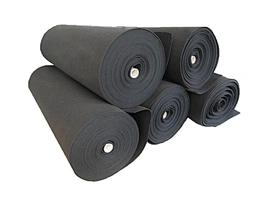


Activated Carbon Fiber




Activated Carbon Fiber
A new type of high-performance adsorption material, due to its unique microporous structure and excellent adsorption performance.
The Manufacturing Process of Activated Carbon Fibers
Pretreatment of Raw Material
Selected raw materials, such as polyacrylonitrile (PAN) and viscose fiber, are processed through catalyst impregnation and oxidation curing to optimize the basic structure of the fibers
Carbonization Treatment
Carbonization is carried out in a nitrogen environment at 300-900℃ to remove non-carbon elements and form a high-purity carbonized fiber framework
Activation Treatment
At a high temperature of 700-1600℃, it is activated by steam/carbon dioxide to form a uniformly distributed nano-scale microporous structure
Forming And Processing
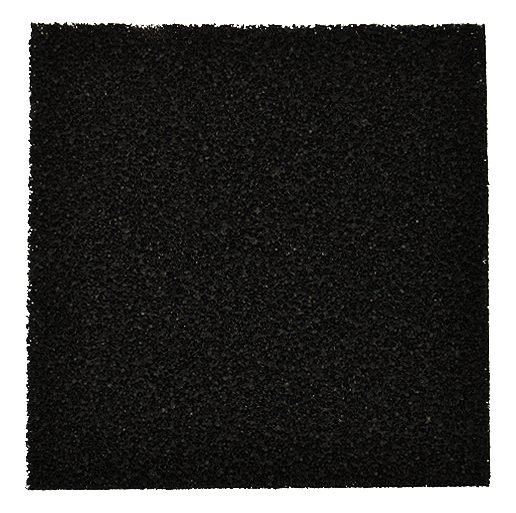
Activated carbon fibers can be processed into various forms such as felt, cloth, paper, net and sheet, which is convenient for use in different application scenarios.

Specification
| Model | Size | Weight (g/m2) | Carbon Content (g/m2) | I.N.P (Pa) | F.N.P (Pa) | Adsorption Efficiency | Deodorization Performance (30 minutes) | Dust Holding Capacity (g/m3) | EFF. (≥5μm) |
|---|---|---|---|---|---|---|---|---|---|
| RT-AC02SF | 1m*50m*2mm | 150 | 75 | 20 | 250 | 90% | >95% | 300 | 90% |
| RT-AC03SF | 1m*50m*3mm | 200 | 100 | 25 | 250 | 90% | >95% | 350 | 90% |
| RT-AC05SF | 1m*50m*5mm | 300 | 150 | 28 | 250 | 90% | >95% | 550 | 95% |
| RT-AC08SF | 1m*50m*8mm | 400 | 200 | 30 | 250 | 90% | >95% | 580 | 95% |
| RT-AC10SF | 1m*50m*10mm | 500 | 250 | 35 | 250 | 95% | >95% | 600 | 98% |
| RT-AC15SF | 1m*50m*15mm | 600 | 300 | 40 | 250 | 95% | >95% | 650 | 99% |
| Remarks: Other specifications can be customized according to requirements. | |||||||||
The Advantages of Activated Carbon Fiber
Strong Adsorption Capacity
Activated carbon fibers have a well-developed microporous structure with a narrow and uniform pore size distribution and a large adsorption capacity. Their adsorption capacity for organic gases, malodorous and fishy substances, inorganic substances in aqueous solutions, dyes, organic substances, and heavy metal ions is much higher than that of granular activated carbon.
Fast Adsorption And Desorption Speed
Due to the small pore size and uniform distribution of activated carbon fibers, the adsorption and desorption processes are rapid, usually reaching adsorption equilibrium within tens of seconds to several minutes. Moreover, regeneration is easy, and complete desorption can be achieved by heating with hot air at 120 to 150 degrees Celsius for 10 to 30 minutes.
Good formability
Activated carbon fibers can be processed into various forms, such as felt, cloth, paper, net, sheet, etc., and have excellent processing performance and plasticity.
Resistant to High temperatures And Corrosion
Activated carbon fibers have high-temperature resistance and can withstand high-temperature environments. At the same time, they have good corrosion resistance to acids and alkalis.
Renewable And Reusable
Activated carbon fibers can be regenerated through heating desorption after reaching adsorption saturation, and they can still maintain their original adsorption performance after multiple uses.
Unique Surface Chemical Properties
The surface of activated carbon fibers is rich in functional groups, which makes the interaction between them and the adsorbate stronger during the adsorption process and leads to higher adsorption efficiency.
The Application of Activated Carbon Fibers
Air Purification And Filtration
Activated carbon fibers are widely used in air purification equipment, such as air purifier filters, air conditioning duct filters, and can effectively remove harmful gases, odors, and bacteria from the air.
Waste Gas Treatment
In industrial waste gas treatment, activated carbon fibers are used to adsorb harmful gases such as volatile organic compounds (VOCs), sulfides, and nitrogen oxides, and they have highly efficient and rapid adsorption capabilities.
Wastewater Treatment
Activated carbon fibers are used in the water treatment field, such as drinking water purification and industrial wastewater treatment, and can effectively remove heavy metal ions, organic pollutants and dyes in water.
Solvent Recovery
In the solvent recovery process, activated carbon fibers are used to adsorb organic solvents such as alcohol and aromatic hydrocarbons, featuring high adsorption capacity and rapid desorption ability.
Medical Care and Pharmaceuticals
Activated carbon fibers are used in the medical field, such as blood purification and drug adsorption, and have good biocompatibility and adsorption performance.
Aerospace and Aviation
Activated carbon fibers, due to their light weight, high strength and excellent adsorption performance, are used as insulation materials and filters in spacecraft and aircraft.
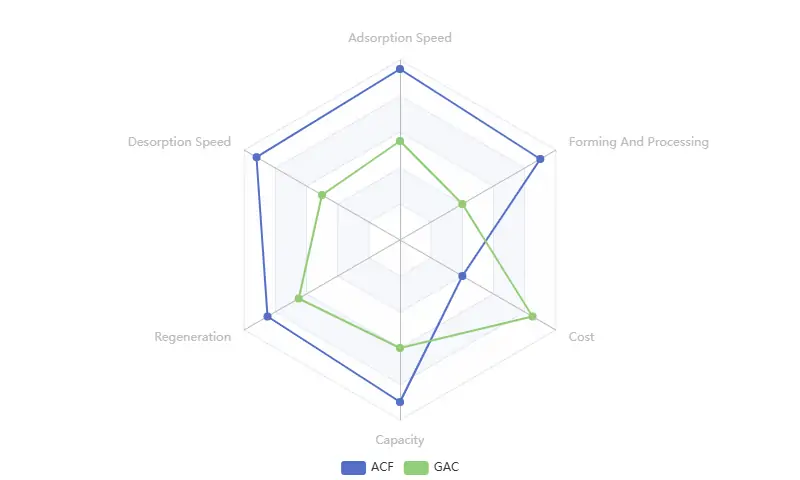
Activated Carbon Fibers VS Granular Activated Carbon
| ITEM | Activated Carbon Fiber | Granular Activated Carbon |
|---|---|---|
| Form | Thin fibers | Irregular granules (0.2–5 mm) |
| Surface Area | Very high (1000–3000 m²/g) | High (500–1500 m²/g) |
| Pore Structure | Predominantly micropores (<2 nm), uniform distribution | Mix of micropores, mesopores (2–50 nm), and macropores (>50 nm) |
| Density | Lower bulk density | Higher bulk density |
| Adsorption Speed | Extremely fast (due to short diffusion paths) | Slower (diffusion into granules takes longer) |
| Capacity | High for small molecules (VOCs, gases) | Better for larger molecules (organics, dyes) |
| Regeneration | Easier (low thermal mass, quick heating) | Harder (requires longer heating) |
| Pressure Drop | Low (when used in filters) | Higher (can cause flow resistance) |
| Air Purification | Masks, HVAC filters, and solvent recovery | Industrial gas treatment, VOC removal |
| Water Treatment | Small-scale, rapid filtration (e.g., home filters) | Large-scale systems (e.g., municipal water treatment) |
| Medical & PPE | Protective clothing, wound dressings | Less common |
| Chemical Processing | Selective adsorption, catalysis | Bulk adsorption, decolorization |
| Production Cost | Higher (specialized manufacturing) | Lower (mass-produced) |
| Lifespan | Shorter (but regenerable) | Longer (but harder to regenerate fully) |
| Ease of Use | Flexible (can be shaped into filters, textiles) | Requires containment (e.g., columns, beds) |





OUR HAPPY CLIENT FROM 98+ COUNTRIES

QUESTIONS AND ANSWERS
Q1: Can You Cut Flat Before Rolling Up On The Paint Stop Filters?
A1: Most Of The Paint Stop Filters On The Market Are Cut Flat After Rolling Up Because It Is Very Easy Operate, There Will Be A Problem That The Edge Is Not Flat. Certainly, We Can Cut Flat Before Rolling Up, Which Can Be Up To 2.6m Wide.
Q2: How Did You Pack HEPA Filter?
A2: One Unit Is Packed With PE Bag Put In 5-layer Carton. If The Customer Is Worried About The Transportation Process, We Can According To The Requirements Of The Form Of Beating Bracket + Corner Protection + Wrapping Film Packing.
Q3: Have HEPA Filter Passed The DOP/PAO Leak Test?
A3: Sure, Our HEPA Filter Is 100% Able To Pass The PAO Test. Because We Will Do An Integrity Test Of Each HEPA Filter For Efficiency And Leakage Before Shipment And Provide A Corresponding Test Report. Any Leakage Will Be Regarded As Unqualified Products And Reworked. We Are Using MPPS Scan Test For HEPA Filter Integrity Test Which According To EN 1822 Standard.
The Scanning Tracks Will Cover The Area:
Inside Filter Material, Sealant, Filter Frame, Corners, Gasket, Seal Of The Filter Mounting Assembly, The Sealant Between Filter Frame And The Gasket
Q4: How Long Does It Usually Take For Me To Receive The Goods?
A4: Depends On Whether You Want To Do Customization Your Air Filters Or Not, And Depends On The Speed Of Customs Clearance And Logistics, But We Can Guarantee To Ship Regular Air Filter In Less Than 7-10 Business Days, And We Have Customers In Singapore Who Received The Goods In Less Than 2 Weeks After We Ship Out.
Q5: What Is The Standard And Certification Of Your Products?
A5: We Implement Our Production Process In Strict Accordance With The Standards Of EN779 And EN1822.
Q6: What Is The Main Material You Are Using For HEPA Filter?
A6: We Usually Use Mircofine Glassfiber Paper, But We Also Can Do Synthetic Type Nano Paper Or PTFE Paper Type.