Spray Booth Air Filtration System Design
Spray booth airflow performance is often evaluated through isolated components such as filters, fans, or duct systems, but in real industrial applications, instability rarely originates from a single element. Instead, airflow issues are typically the result of imbalance across the entire air path, from intake to spray zone to exhaust. When one stage behaves abnormally, it affects pressure distribution and ultimately leads to misinterpretation of system performance, especially in relation to filter condition and pressure drop readings.
Air Intake Stage and Its Role in Airflow Stability
In many spray booth systems, the intake stage is underestimated because it is not directly associated with overspray capture. However, in actual operation, the intake section plays a fundamental role in defining airflow uniformity inside the booth. Ceiling filters and intake pre-filtration layers do not simply remove particles; they regulate how air enters the system and how evenly it is distributed across the spraying environment.
When intake resistance increases or the filter surface becomes unevenly loaded, airflow entering the booth loses uniformity. This does not immediately appear as a failure, but it gradually affects downstream conditions by creating uneven velocity fields, which later influence both overspray behavior and exhaust loading patterns.
Spray Zone as a Controlled Airflow Environment
The spray zone is where airflow stability becomes directly visible through coating quality, although the underlying cause is often upstream or downstream of this area. Within this section, the goal is not filtration but maintaining a controlled and predictable airflow field that supports consistent atomization and overspray transport.
When airflow entering the spray zone is already uneven due to intake imbalance or exhaust resistance changes, turbulence begins to form. These flow disturbances do not only affect paint deposition but also redistribute overspray particles unevenly, which indirectly accelerates localized filter loading in the exhaust stage.
Exhaust Filtration and Progressive Overspray Loading
The exhaust stage is where most operational attention is typically focused, as it directly deals with overspray accumulation and pressure drop behavior. In practice, this section operates as a progressive loading system rather than a single filtration barrier. Different media types handle different stages of overspray saturation, and their behavior changes significantly under continuous operation.
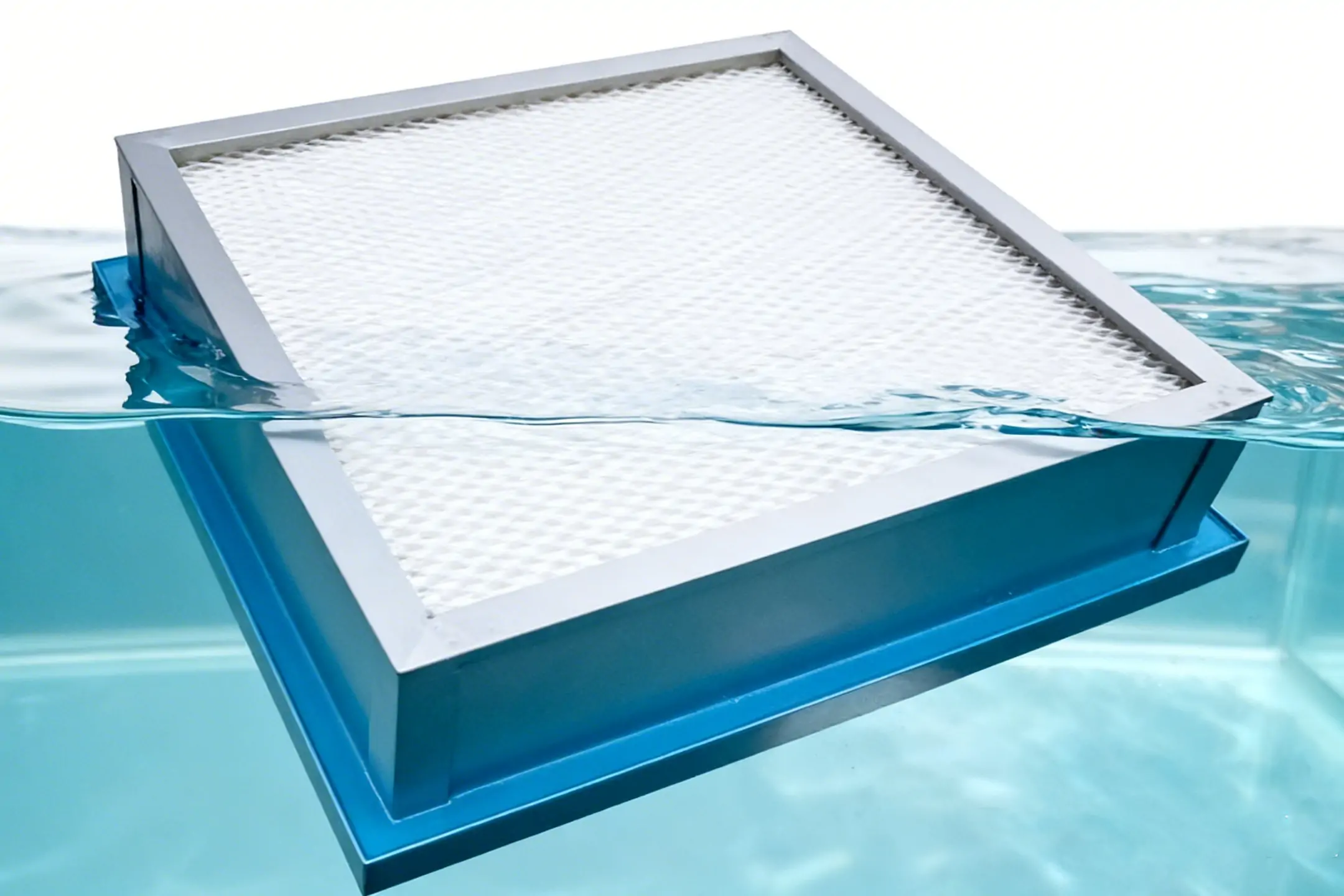
Light-duty paint arrestor materials typically handle initial overspray capture but tend to reach resistance limits quickly under heavy coating conditions. As loading increases, deeper filtration structures such as DPA media or fiberglass-based solutions begin to play a more significant role in stabilizing pressure drop behavior. In more structured systems, accordion-style or V-type media increases effective surface area, extending service life by distributing loading more evenly.
However, regardless of media type, the exhaust stage does not function independently. Its loading behavior is directly influenced by intake stability and spray zone airflow conditions.
System-Level Interaction and Misinterpretation of Pressure Drop
One of the most common misunderstandings in spray booth operation is interpreting pressure drop as a direct indicator of filter failure. In reality, pressure behavior is the result of system-wide airflow resistance, not isolated filter condition. When airflow is maintained under constant velocity control, the system continuously compensates for resistance changes by adjusting pressure output, which causes differential pressure readings to rise even when filter saturation is not yet complete.
This creates a gap between perceived filter life and actual filtration capacity, leading operators to replace filters earlier than necessary. In many cases, the issue is not the filter itself but the interaction between intake restriction, spray zone turbulence, and exhaust loading behavior.
Engineering Perspective on Spray Booth Air System Balance
From an engineering standpoint, spray booth airflow should be understood as a continuous resistance network rather than a collection of independent components. Intake filtration defines entry conditions, the spray zone governs airflow behavior during coating, and the exhaust stage manages progressive loading. When these three stages are not properly balanced, the system enters a compensatory state where pressure increases without corresponding physical failure of individual components.
Understanding this interaction is critical for improving both operational stability and cost efficiency. Instead of evaluating filters in isolation, system performance should be assessed based on overall airflow behavior, resistance growth patterns, and control strategy.
RT Air Filtech System-Level Filtration Approach
RT Air Filtech provides integrated air filtration solutions designed for full spray booth airflow systems, including intake filtration media, paint arrestor and DPA exhaust solutions, and customized media structures for different overspray loads. By focusing on balanced airflow resistance, progressive loading control, and system compatibility, our solutions help maintain stable performance across the entire air path, reducing premature maintenance signals and improving long-term operational consistency in industrial coating environments.
Contact RT Air Filtech for your requirement.