How to Choose the Right Type of Bag Filters for HVAC Systems
Bag filters (pocket filters) remain a cornerstone of HVAC filtration across commercial and industrial installations. Their multi-pocket design gives a large filtration area and high dust-holding capacity, delivering stable airflow and reliable particle capture for AHUs, ventilation systems, and pre-filtration stages before HEPA.
What Are Bag Filters and Why They Matter
Bag filters are medium to high-efficiency filters made from multi-pocket fabric media that open into several pockets as air flows through them. Because the media is arranged in deep pockets, bag filters offer far more surface area than flat panel filters—this translates into better dust-holding capacity, longer service life, and lower pressure rise over time.
In HVAC systems, bag filters:
- Protect downstream equipment (coils, fans, motors) from contamination.
- Improve indoor air quality by removing PM10/PM2.5, pollen, fibers, and other particulates.
- Stabilize system airflow and reduce energy waste compared with clogged, low-capacity media.
Core Functions in HVAC Applications
- Air Quality Control: Removes particles that affect occupant comfort and health.
- Equipment Protection: Prevents fouling of sensitive components, lowering maintenance costs.
- Operational Efficiency: Large dust-holding capacity extends replacement intervals and keeps pressure drop lower for longer.
- System Flexibility: Available in multiple efficiencies for use as pre-filters, mid-stage filters, or pre-HEPA stages.
| Bag Filter Efficiency (ISO / MERV) | Typical Use Cases | HVAC Application Scenarios |
|---|---|---|
| ISO Coarse / ePM10 50% (≈ MERV 8–9) |
Coarse dust capture, pollen, lint | - Pre-filtration for commercial buildings - Protects coils and fans - Malls, warehouses, supermarkets |
| ISO ePM2.5 50–60% (≈ MERV 10–11) |
Medium efficiency particle control | - General HVAC for offices, schools - Worker-occupied industrial spaces - Multi-stage filtration systems (as Stage 2 before finer filters) |
| ISO ePM2.5 65–75% (≈ MERV 12–13) |
Finer particulate reduction (PM2.5) | - Hospitals (non-critical areas) - Airports, hotels, laboratories (general areas) - Residential AHUs requiring improved IAQ |
| ISO ePM1 60–70% (≈ MERV 14) |
High-efficiency particulate control | - Pre-HEPA in cleanrooms - High-end commercial HVAC - Healthcare facilities requiring controlled particle counts |
| ISO ePM1 80–90% (≈ MERV 15–16) |
Very fine particle control / pathogen-lowering airflow | - Pharmaceutical HVAC - Surgical prep rooms (pre-HEPA stage) - Animal farms / swine facilities (disease control) - High-risk industrial process rooms |
| Activated Carbon Pocket Filter (odor + VOC control) |
Gas & odor adsorbing | - Food & beverage plants - Waste adsorption areas - Lab ventilation, printing factories - Buildings near traffic or pollution sources |
| High-Temperature or Fiberglass Bag Filters | Stable under high temperature or harsh particles | - Industrial furnaces - Metalworking plants - Heavy production with abrasive dust |
Types / Product Options (based on your product classification)
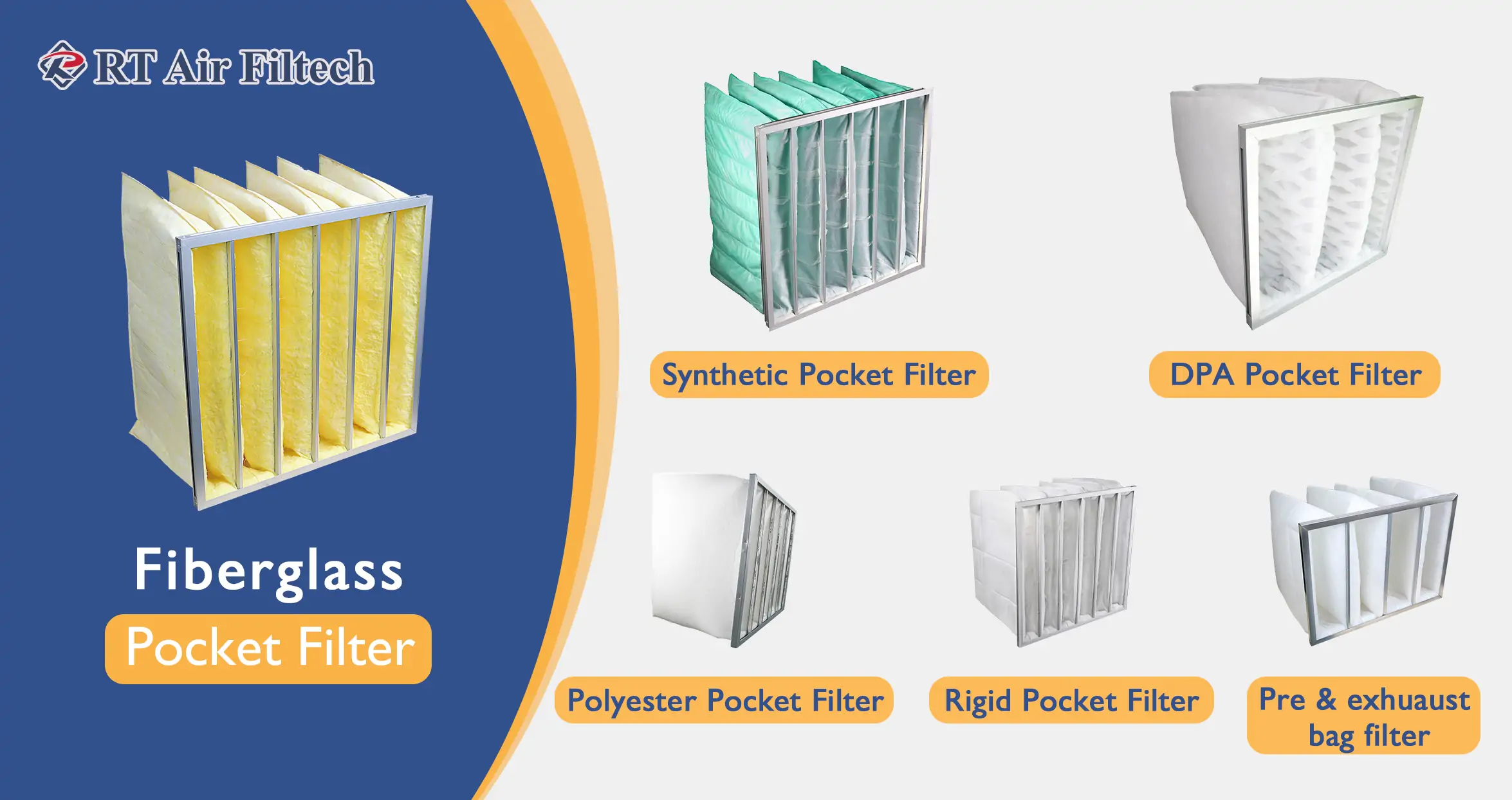
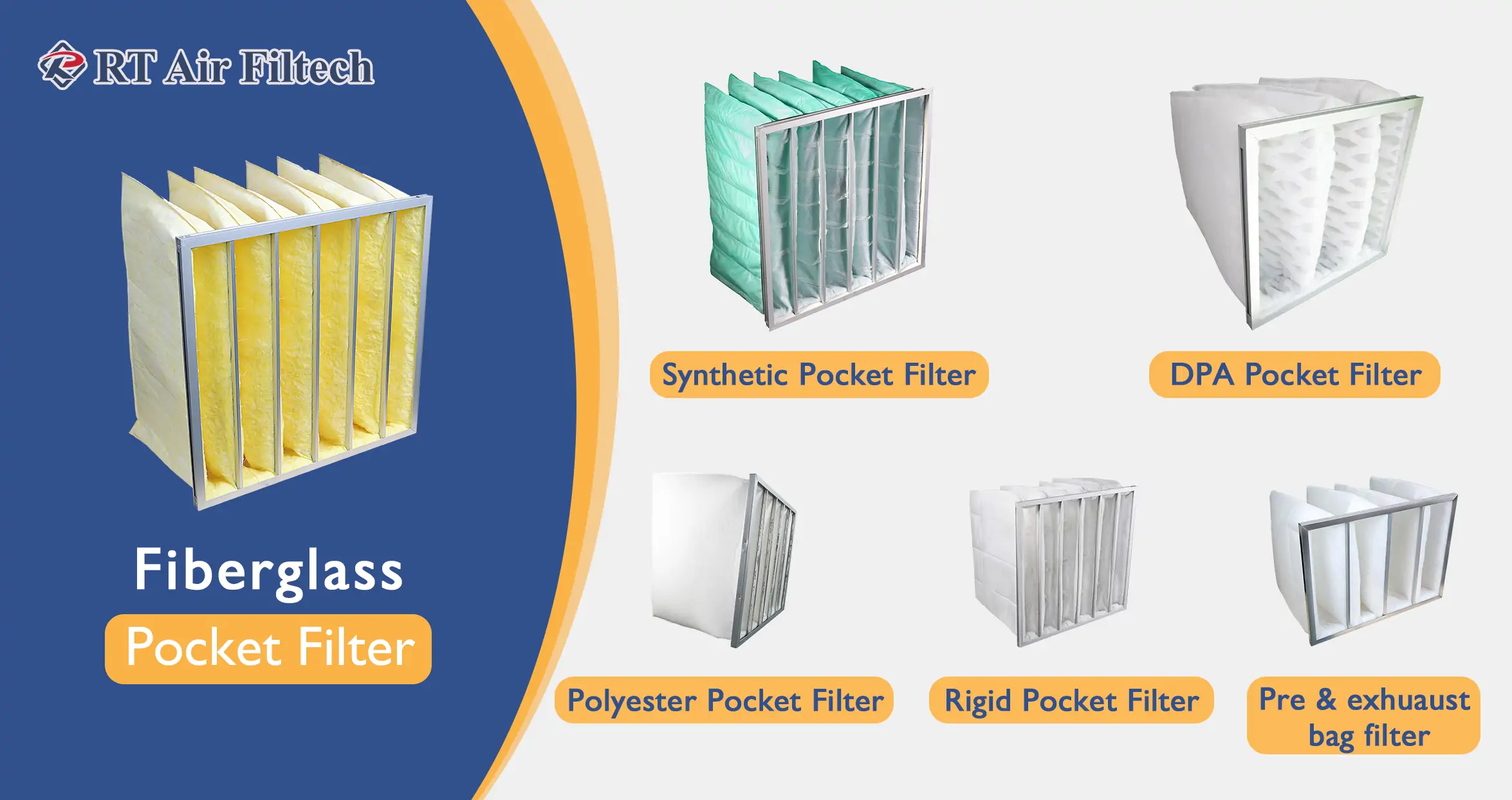
1. Fiberglass Pocket Filter
- Best for: Industrial applications with high temperature or abrasive particulate loads.
- Benefits: Good initial dust loading capacity and often higher tolerance to temperature.
- Typical uses: Industrial AHUs, heavy manufacturing, coarse pre-filtration.
2. Synthetic Pocket (Non-Woven) Filter
- Best for: General commercial HVAC where moisture resistance and consistent performance matter.
- Benefits: Stable performance in humid environments, longer life than basic panel filters.
- Typical uses: Office buildings, malls, schools, HVAC pre-filtration.
3. Rigid Pocket Filter
- Best for: Applications requiring robust physical structure and minimal deformation under airflow.
- Benefits: Strong frames and rigid support keep pocket shape in heavy airflow or turbulent conditions.
- Typical uses: Large AHUs, airport ventilation systems, places with variable airflow demands.
4. Activated Pocket Filter (with Carbon Layer)
- Best for: Sites where gas-phase contaminants and odors (ammonia, VOCs) must be reduced.
- Benefits: Combined particulate capture + gas adsorption for odor control and improved air quality.
- Typical uses: Food processing, laboratories, waste-adjacent facilities.
How to Choose the Right Bag Filter for Your HVAC System
1. Define your target contaminant: Is the priority dust control, allergen reduction, odor/gas removal, or protecting downstream HEPA?
2. Select the appropriate media: Choose fiberglass for temperature/abrasion resistance, synthetic for moisture stability, or activated carbon for odor control.
3. Match efficiency rating to application: Use ISO ePM10/ePM2.5 or MERV ratings to align with indoor air quality requirements and local regulations.
4. Consider pocket count & depth: More pockets (and deeper pockets) = more surface area = longer life and lower pressure rise. Typical pocket depths: 400mm / 500mm / 600mm.
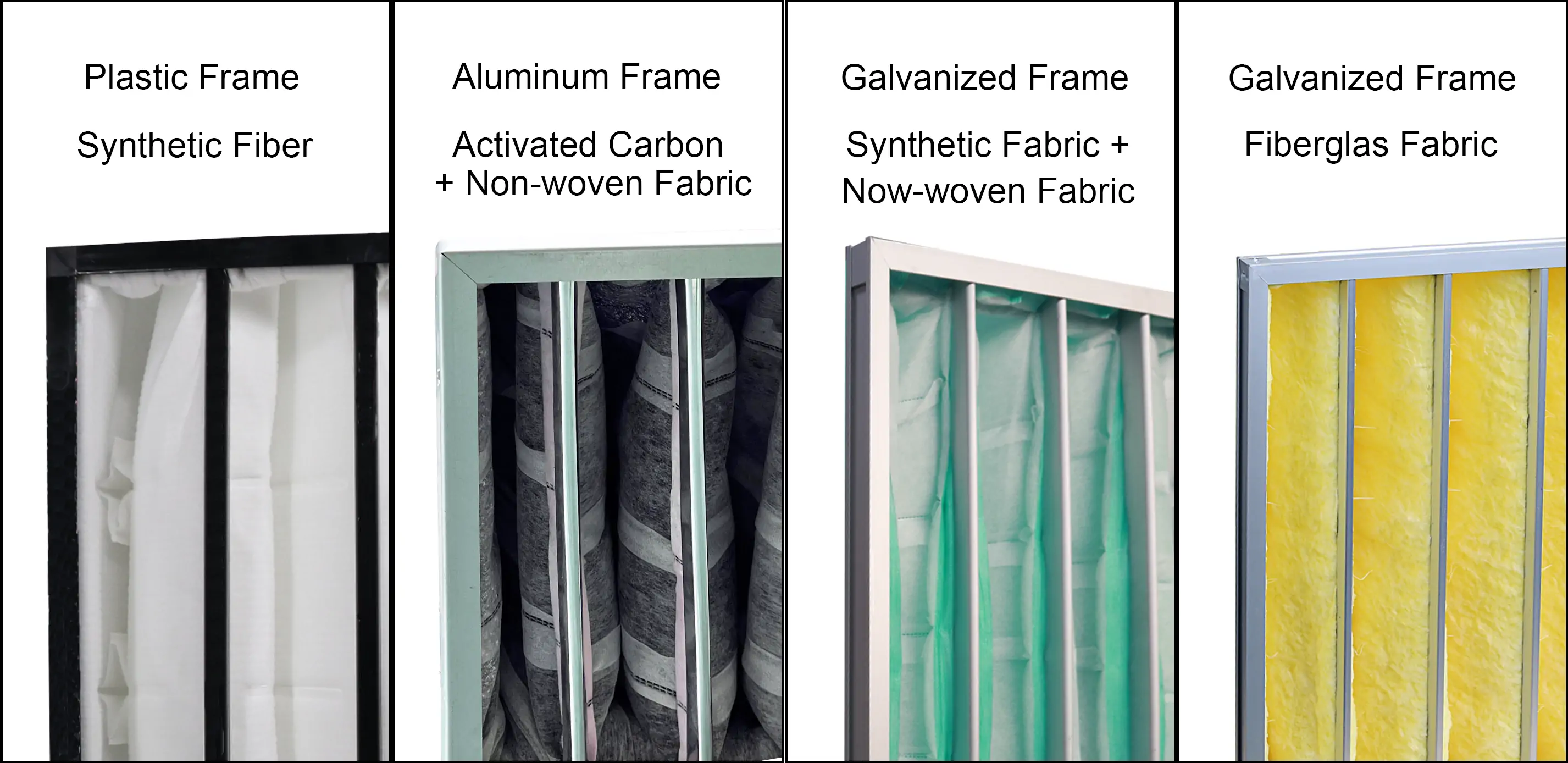
5. Pay attention to frame & sealing: A well-sealed frame (galvanized steel, plastic, or aluminum) prevents bypass and ensures filter performance.
6. Check operating conditions: Temperature, humidity, and particulate type affect both choice and replacement schedule.
7. Test & monitor: Use differential pressure gauges to determine real replacement points rather than only following calendar schedules.
Common Problems and Practical Fixes
- Premature clogging: Select a higher dust-holding media or add a pre-filter stage.
- High pressure drop: Verify correct filter size, pocket count, and filter orientation; confirm AHU fan capacity.
- Filter bypass/leakage: Improve sealing at frame and housing; use gasketing where applicable.
- Physical damage: Choose rigid pocket filters or reinforced seams for high-velocity or turbulent inlets.

Closing & Where to Learn More
Bag filters are a proven, cost-effective solution for maintaining IAQ and protecting HVAC systems across many sectors. To see the full product family and select the right option for your system, visit the bag filter category:www.rtfilters.com/bag-filters