Paint Arrestor Filter Boxes: Direct Interception vs. Inertial Collision
Paint Arrestor Filter Boxes: Direct Interception vs. Inertial Collision
In dry spray booth operations, paint arrestor filter boxes serve as the primary pre-filtration stage. They directly determine the total overspray capture capacity of the system and significantly influence the service life of downstream medium-efficiency bag filters. Today’s market offers a wide variety of paint arrestor filter boxes, but most designs are built around two fundamental physical mechanisms: direct interception filtration and inertial collision filtration. This article explains both mechanisms in detail and compares real product structures to help procurement and engineering teams select the most cost-effective graded filtration setup based on actual coating conditions, such as manual spraying or robotic painting lines.
1. Direct Interception Filtration and Typical Products
What is Direct Interception?
Direct interception (also known as surface capture) occurs when paint mist particles carried by airflow come into close proximity with the filter media and are captured upon contact. In simple terms, if a particle passes too close to a fiber or surface, it is “intercepted” and retained. In general, larger particles and tighter filter structures result in higher interception efficiency.
Honeycomb Cardboard Paint Arrestor Box
This type of filter uses multiple layers of kraft paper with staggered perforations (typically 9-layer structure). The final layer is usually a non-woven fabric that stabilizes filtration accuracy.
Filtration behavior: As airflow passes through the honeycomb structure, paint overspray repeatedly contacts internal surfaces. Larger particles are directly captured, while smaller particles may also be trapped through random “bridging effects” formed inside the channels.
Application recommendation: Because the final layer is only an initial-efficiency non-woven media, honeycomb cardboard filters are typically used together with medium-efficiency bag filters to protect downstream ducting and equipment. They are widely applied in automotive OEM production lines and can support continuous high-volume operations.
Limitation: In coating lines with high fine-mist generation (especially topcoat systems), downstream bag filters may experience faster loading and shorter service life.
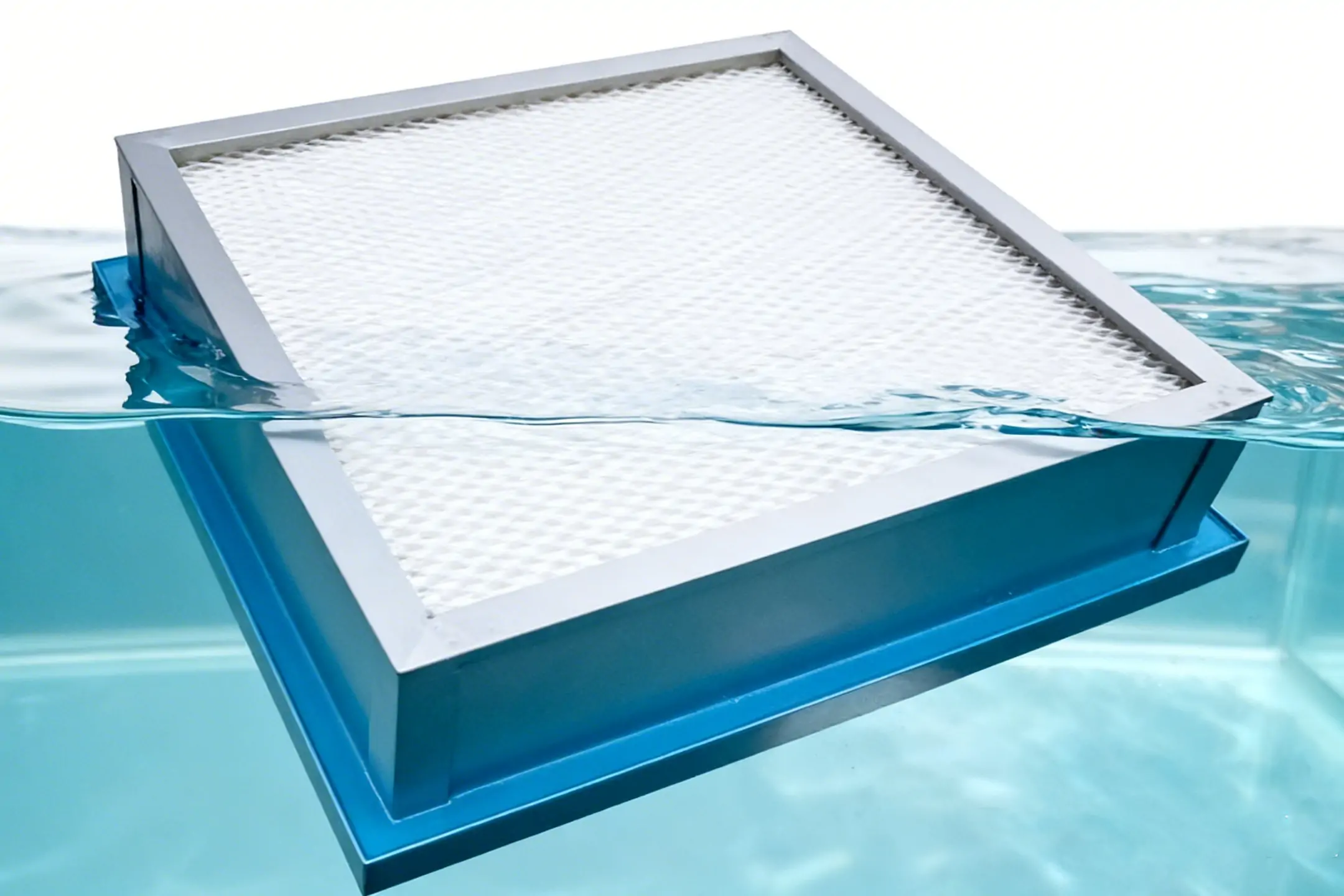
DPA Honeycomb Paint Arrestor Box
The DPA honeycomb filter is an engineered interception system designed for higher structural stability and controlled dust loading behavior. Its structure ensures that airflow channels remain stable even under heavy paint loading conditions.
Filtration performance: For overspray particles larger than 10 μm, it can achieve a capture efficiency of up to 99.34%, corresponding to an approximate F5-level performance. It also features a high-capacity internal structure, with a maximum paint holding capacity of up to 27 kg, making it suitable for long-cycle industrial operation.
Application recommendation: In many industrial spray booth systems, a single DPA honeycomb stage can provide sufficient protection for downstream systems. This reduces installation complexity, saves space, and significantly lowers the consumption rate of secondary bag filters. It is a balanced solution combining high dust holding capacity and stable filtration efficiency.

Honeycomb Paper vs DPA Honeycomb — Practical Selection Insight
When overspray contains a higher proportion of large particles, traditional honeycomb paper filters may demonstrate slightly higher initial paint loading capacity. However, in modern automotive robotic coating lines (such as bumper painting systems), overspray tends to be high in volume but fine in particle size. In such conditions, standard honeycomb filters can overload downstream bag filters relatively quickly, shortening their service life. The DPA honeycomb structure performs better in these scenarios because it provides more stable fine-mist handling and extends the overall operating cycle of the filtration system.
2. Inertial Collision Filtration and Typical Products
What is Inertial Collision?
Inertial collision occurs when airflow changes direction rapidly inside the filter structure. Larger particles with higher mass cannot follow the sudden airflow path changes and therefore collide with the filter walls, where they are captured. In general, the larger the particle and the higher the airflow velocity, the stronger the inertial capture effect.
Product Example: Classic Labyrinth Paint Arrestor Box
The labyrinth filter is one of the earliest designs used in paint mist filtration. Air carrying paint overspray is forced through multiple directional changes, creating repeated opportunities for particles to impact and adhere to internal surfaces.
Limitation: This mechanism is highly dependent on particle mass. When overspray particles are fine (for example, many robotic coating processes in automotive plants generate particles smaller than 10 μm), these small particles tend to follow airflow streamlines and pass through the labyrinth structure. As a result, downstream bag filters are subjected to significantly higher loading and pressure drop, which can quickly reduce ventilation efficiency in the system.
3. Conclusion: How to Build a Low-Cost Graded Filtration System
Based on the analysis of both mechanisms, several practical conclusions can be drawn: Interception-based filters (such as honeycomb paper and DPA honeycomb systems) are well suited for most industrial coating applications, especially where fine mist (<10 μm) is dominant. They are typically the preferred choice for modern high-performance spray booths. Inertial collision filters (such as labyrinth systems) provide excellent initial capture of large particles while maintaining low initial airflow resistance.
Most cost-effective configuration in real production: Instead of choosing one system over the other, the most efficient solution is a graded combination approach: Use a labyrinth filter as the first-stage pre-filtration layer to capture large particles and reduce initial system resistance. Follow with a DPA honeycomb filter as the second-stage fine mist capture layer. Then protect downstream medium-efficiency bag filters and exhaust/VOC systems. This layered design significantly increases total overspray capture capacity, extends the service life of high-value downstream filters, and reduces overall hazardous waste generation and operating cost across the entire coating system.