Reduce HVAC Energy Costs with Better Bag Filters
HVAC systems rank among the largest energy consumers in modern buildings, typically accounting for one-third to half of total electricity usage. As energy costs continue to increase, many facility managers focus their attention on motors, ductwork, or control systems, rarely realizing that air filtration systems are one of the hidden causes driving up energy consumption. Particularly, the selection and maintenance practices for bag filters directly impact air resistance, system pressure, and overall energy efficiency.
An improperly sized or poorly performing filter can silently inflate monthly electricity bills. Conversely, a well-chosen filter can significantly reduce operating costs.
Air Filters and Their Impact on HVAC Energy Consumption
Pressure drop indirectly leads to increased costs.
Each filter creates a certain amount of air resistance, known as pressure drop. As pressure drop increases, HVAC fans must work harder to maintain airflow. Greater resistance leads to higher energy consumption.
If a filter is of poor quality, has high initial resistance, or clogs easily, the system will consume more electricity under the same operating conditions.
How Poor Filter Quality Increases Operating Expenses
- Uneven dust capture by filter media leads to localized excessive clogging
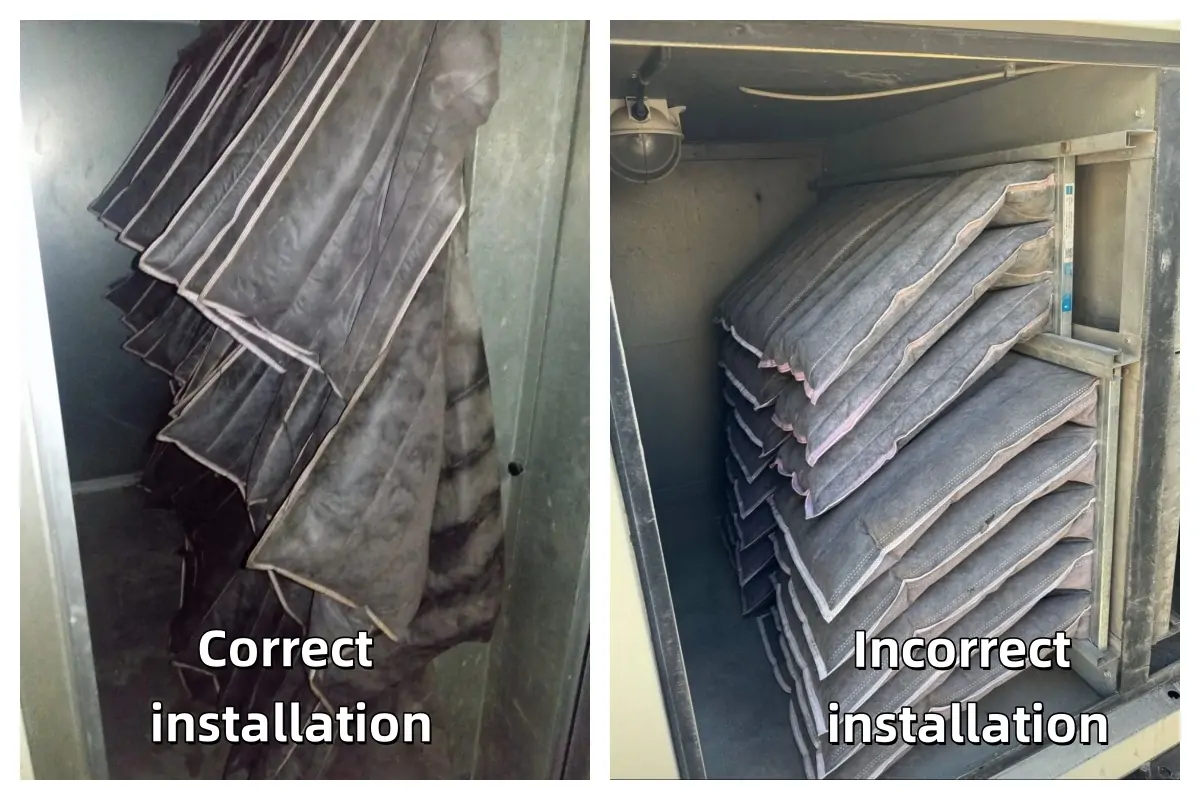
- Filter bag structure is unstable and prone to collapsing into the airflow path
- Material shedding causes downstream coil blockage
- Short service life with rapid pressure drop increase
Why Your HVAC System Might Be Using More Energy Than Expected
In many buildings, increased energy consumption is often associated with factors related to filters, such as
- Use of inefficient filters prone to clogging
- Material selection unsuitable for local environmental or dust conditions
- Excessively long replacement intervals
- Mismatched filter bag dimensions
- High humidity causing filter bag deformation or sagging
- Poor sealing resulting in air bypass
Even slight bypass leakage or filter bag deformation can lead to dual losses in filtration efficiency and energy consumption.

Case Study: How One Building Reduced Energy Consumption by 18%
An office building in Southeast Asia experienced a significant increase in energy consumption over the course of a year, particularly during summer months, with the HVAC system accounting for nearly half of total electricity usage. The technical team initially suspected aging equipment, refrigerant deficiency, or declining fan performance, but upon inspection, the real issue was traced to the filters.
The low-cost non-woven fabric bag filters originally used exhibited high initial resistance and were prone to localized clogging and bag sagging within less than two months of use. This caused a sharp drop in airflow. To maintain temperature, the system had to increase fan output, directly driving up energy consumption.
The facility team subsequently switched to high-quality synthetic fiber bag filters and recalibrated the filter replacement cycle. Monitoring data from the first six months after the change showed:
- Average energy consumption decreased by 18%
- System pressure loss reduced by approximately 35%
- Improved indoor airflow stability
- Reduced operating time of the main unit
The cost of replacing filters is significantly lower than the savings achieved through energy efficiency, making it one of the most cost-effective optimization measures available.
How High-Quality Bag Filters Help Reduce Energy Consumption
Lower Resistance Keeps Fans Working Efficiently
Well-designed synthetic fiber, glass fiber, or rigid filter bags maintain stable and low pressure drop throughout their entire service life. This ensures smoother airflow, thereby enhancing fan efficiency.
Longer Lifespan Means Fewer Energy Penalties
High-quality filter bags feature more uniform material, enabling dust to distribute across a larger surface area. This significantly extends the service life of the filter bags and allows the system to maintain low pressure drop for extended periods.
Higher Dust-Holding Capacity Protects the System
High-quality filter bags not only hold more dust but also protect downstream equipment such as coils, cartridge filters, or HEPA filters, reducing additional load and maintenance costs.
Choosing the Right Bag Filter for Energy Savings
Different filter types serve different environments. Selecting the proper one has a direct impact on energy savings:
- Synthetic pocket filters: Ideal for commercial HVAC systems requiring stable resistance and long service life.
- Fiberglass pocket filters: Well-suited for high-dust or high-temperature applications in industrial facilities.
- Activated pocket filters: Offer both particle filtration and odor/VOC removal, perfect for environments with chemical or scent pollutants.
- Rigid pocket filters: Provide excellent structural stability for high-velocity HVAC systems, such as airports, data centers, or pharmaceutical plants.
Choosing a filter that matches the system's airflow and environment ensures optimal performance without unnecessary power consumption.
Signs Your Bag Filter Needs to Be Replaced
If you notice the following conditions, it typically indicates that the filter is increasing the system load and driving up energy consumption:
- Reduced airflow
- Rising pressure gauge readings
- Persistently increasing electricity bills despite normal equipment operation
- Dust accumulation on coils or ductwork
- Collapsed or visibly deformed filter bags
Timely replacement prevents the system from operating under sustained high load conditions.
Air filtration plays a critical role in the energy performance of HVAC systems. Selecting high-quality, properly matched bag filters can help reduce pressure drop, stabilize airflow, and lessen equipment strain, thereby significantly lowering energy expenditures. For most buildings, optimizing filters ranks among the most cost-effective and fastest-paying energy-saving measures.