How Does the Structure of the Paint Booth Ceiling Insulation Affect Air Resistance?
In the air purification system of a paint booth, the performance of the ceiling filter is fundamental to guaranteeing final product quality and system operating efficiency. As the final stage fine filtration unit, the core function of the ceiling filter lies in high-efficiency particle interception while maintaining stable Airflow Stability. However, actual operating data shows that the Pressure Drop of the filtering material increases as the Dust Holding Capacity accumulates. This change is directly linked to the paint booth's energy consumption, fan load, and the stability of the internal laminar flow environment.
This article will compare the mainstream full glue ceiling filter and surface glue ceiling filter available on the market. We will analyze how their microscopic structures affect the Pressure Drop Curve, and based on this, quantitatively evaluate the actual economic benefits of the two types of materials in terms of service life, maintenance cycle, and Total Cost of Ownership (TCO).
How Does the Structure of Paint Booth Ceiling Filter Affect Initial Pressure Drop and Dust Holding?
The macroscopic performance differences of ceiling filter materials stem from their microscopic fiber structure and adhesive treatment process. The two treatment methods—full glue and surface glue —fundamentally determine the material's Initial Resistance and capacity to hold dust particles.
Full Glue Ceiling Filter: Deep Gradient Filtration and Low Initial Pressure Drop
The full glue process involves completely immersing the fiber substrate in a special adhesive solution, using high-pressure penetration and curing to uniformly distribute the adhesive within the fibers and their internal pores. This treatment constructs a three-dimensional integrated structure.
- Porosity Advantage and Initial Resistance: Full glue typically achieves a Density Gradient design. This means the fiber structure on the upstream side is relatively loose, while the downstream side gradually tightens. This gradient structure is able to effectively disperse the airflow resistance , preventing the airflow from being overly restricted at a single cross-section. Therefore, its Initial Pressure Drop often remains at a low level, ensuring low energy consumption during the fan startup phase.
- Depth Filtration Mechanism: The uniform adhesive penetration inside the material provides a large amount of three-dimensional collection space for particles. Pollutants do not just remain on the surface; they are captured layer by layer by the fibers and adhesive. This deep filtration mechanism maximizes the Dust Holding Capacity space, serving as the technical basis for achieving high Dust Holding Capacity and long service life
Surface Glue Ceiling Filter: Surface Interception and Risk of Rapid Pressure Drop Increase
The surface glue ceiling filter adopts a relatively simpler process, which involves uniformly coating a layer of viscous substance on the upstream side or both sides of the high-performance fiber substrate. This structure relies more on the surface tackification effect and mechanical interception by the fibers.
- Initial Resistance and Uniformity: Although the surface glue process aims to retain the original flexibility of the fibers, if the distribution or thickness of the adhesive is slightly uneven during the coating process, it may lead to some surface pores being excessively blocked. This may cause the material's Initial Pressure Drop fluctuation to be greater , and local airflow resistance may be higher than expected.
- Surface Interception Mechanism: The Dust Holding Capacity of this material mainly relies on the adhesive layer on the upstream side. When particles are captured by the adhesive layer, the lack of deep collection space causes the dust to rapidly form a dense Dust Cake on the material's surface. While this mechanism offers high interception efficiency in the short term, it causes a rapid reduction in the effective airflow channel, which is the main structural reason for the rapid increase in Pressure Drop in the later stage.
How Does the Pressure Drop Curve of the Ceiling Filter Predict Dust Holding Capacity?
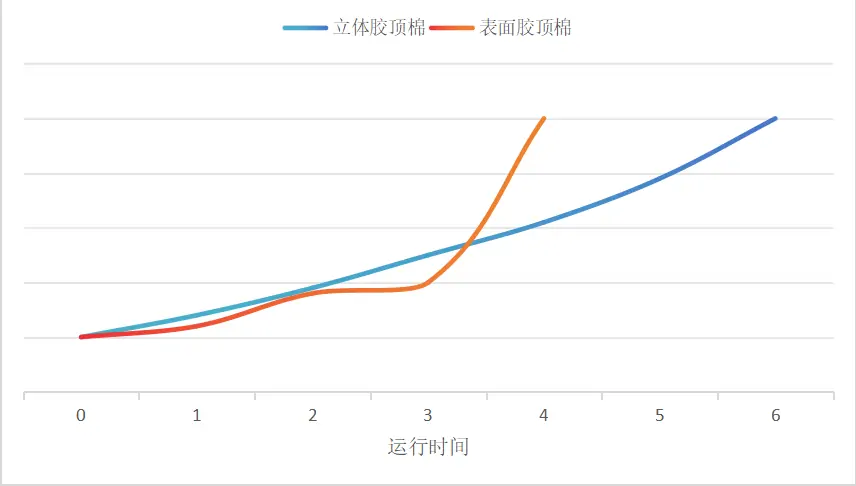
The economic assessment of the ceiling filter must be based on its performance throughout its entire service life. In the actual operation of the paint booth, we use the resistance reaching the system-set Final Pressure Drop (e.g., 250Pa or 400 Pa) as the judgment criterion for the end of the material's life. By comparing the Pressure Drop Curve of the two materials, the significant differences in their dust holding performance can be visually revealed.
Pressure Drop Curve Shape Analysis
We test the two types of ceiling filter by simulating the paint booth environment, plotting the resistance curve with running time or cumulative Dust Holding Capacity on the horizontal axis
- Surface Glue Ceiling Filter: The Pressure Drop Curve exhibits a typical J-shaped or exponential upward trend. The curve is stable in the early stages of the test, but as the surface dust cake rapidly forms, the effective airflow channel is quickly blocked, causing the curve slope to sharply increase in the middle and late stages of dust accumulation.
- Full Glue Ceiling Filter: The Pressure Drop Curve presents a smooth, nearly linear, gentle slope from the initial value to the Final Pressure Drop. Its deep gradient structure ensures the stability and continuity of the dust accumulation process, where airflow resistance accumulates uniformly rather than in sudden, concentrated bursts.
Will the Pressure Drop Fluctuation of the Paint Booth Ceiling Filter Increase Energy Consumption?
The difference in the Pressure Drop Curve is central to evaluating the long-term economic benefits of the two types of ceiling filter. Any product selection involves a trade-off. Surface glue ceiling filter holds an advantage in certain operating models due to its unique market positioning, while full glue offers long-term stable performance.
Trade-off Between Energy Consumption and Fan Efficiency
Fan energy consumption is closely related to the rise in resistance.
- Energy Consumption Control of Full Glue: Its resistance curve rises smoothly, allowing the paint booth to maintain a lower average airflow resistance over a longer operating cycle. This directly translates into stable and predictable energy consumption, which is beneficial for energy efficiency management.
- Initial Economic Advantage of Surface Glue: The Initial Purchase Price of surface glue is typically lower than full glue. This represents a significant initial cost advantage for short-term projects with budget constraints or those requiring rapid startup.
Optimization of Maintenance Cycle and Labor Costs vs. Logistics Risk
Total Cost of Ownership (TCO) must account for all stages, from procurement to disposal.
- Long-Term TCO Advantage of Full Glue: Due to its high Dust Holding Capacity, and longer replacement cycle (up to 6–8 months), full glue significantly reduces the number of annual maintenance cycles. This saves labor costs and non-productive downtime.
- Risk Note: Precisely because of the deep internal adhesive immersion, full glue material faces the risk of fiber sticking under high-pressure stacking, improper transportation, or unsuitable storage (e.g., high temperatures). Once sticking occurs, it can cause surface unevenness or abnormal density in the material, potentially leading to excessive local airflow resistance after installation. Suppliers and users must pay close attention to this risk during logistics and warehousing.
- Convenience Advantage of Surface Glue: Surface glue material is typically more flexible, making the installation and replacement process simple and fast. Furthermore, its structural characteristics result in an extremely low risk of sticking during transport and storage, requiring less management complexity, which is an inherent advantage in the logistics chain.
Paint Quality and Airflow Stability
Pressure Drop stability is central to ensuring paint quality.
- Quality Assurance of Full Glue: Its ΔP changes slowly and stably, ensuring the Airflow Stability and continuous stability of the laminar flow state in the paint booth throughout the entire service cycle. This minimizes the risk of rework caused by airflow disturbances.
- Application Positioning of Surface Glue: Surface glue offers efficient particle interception in the initial stages of use or in applications where paint surface requirements are not extremely strict. However, companies must accept the airflow attenuation and potential quality fluctuation risks that may arise from the rapid ΔP increase later on.
How to Select the Appropriate Ceiling Filter for the Paint Booth?
| Product Type | Full Glue Ceiling Filter | Surface Glue Ceiling Filter |
|---|---|---|
| Core Advantage | Excellent Dust Holding Capacity, stable resistance curve, low long-term TCO, high-quality assurance. | Low initial purchase cost, convenient installation and replacement, low transport and storage risk. |
| Main Challenge/Limitation | High initial purchase cost; high requirements for logistics and warehousing management, need to guard against sticking risk | Limited Dust Holding Capacity, steep resistance curve in the later stage, high replacement frequency, high risk of airflow fluctuation in the later stage. |
| Applicable Scenario | Automotive OEM, high-end refinish, high-frequency continuous operation, work conditions with stringent paint quality requirements. | Budget constraints, low operating frequency, short-term projects, or industrial spraying where paint quality requirements are relatively relaxed |
When making the final decision, companies should shift their perspective from the purchase price to the life cycle cost:
- If the paint booth operates under high load continuously, requires strict zero-defect paint finishes, and prioritizes energy efficiency management, full glue ceiling filter is undoubtedly the more reliable choice with greater long-term economic benefits.
- If the focus is on reducing initial investment, simplifying maintenance procedures, and accepting a higher tolerance for Pressure Drop changes, surface glue ceiling filter can meet the basic filtration needs.
Ultimately, accurate selection is the first step in optimizing paint booth operation, and continuous monitoring and management of the resistance curve are crucial for ensuring high-quality production and controlling costs.