What Is MPPS in HEPA Filters?
What Is MPPS in HEPA Filters?
When discussing HEPA filter efficiency, one technical term appears repeatedly: MPPS. MPPS stands for Most Penetrating Particle Size. It represents the particle size that is the most difficult for a filter to capture.
Understanding MPPS is essential for anyone working with H13 or H14 HEPA filters, because efficiency classification is measured specifically at MPPS, not at random particle sizes.
Why MPPS Matters in HEPA Filtration
HEPA filters do not capture all particle sizes with the same efficiency. Filtration occurs through several mechanical mechanisms:
- Inertial impaction
- Interception
- Diffusion
Larger particles are typically captured by impaction and interception. Extremely small particles are captured effectively through diffusion due to Brownian motion.
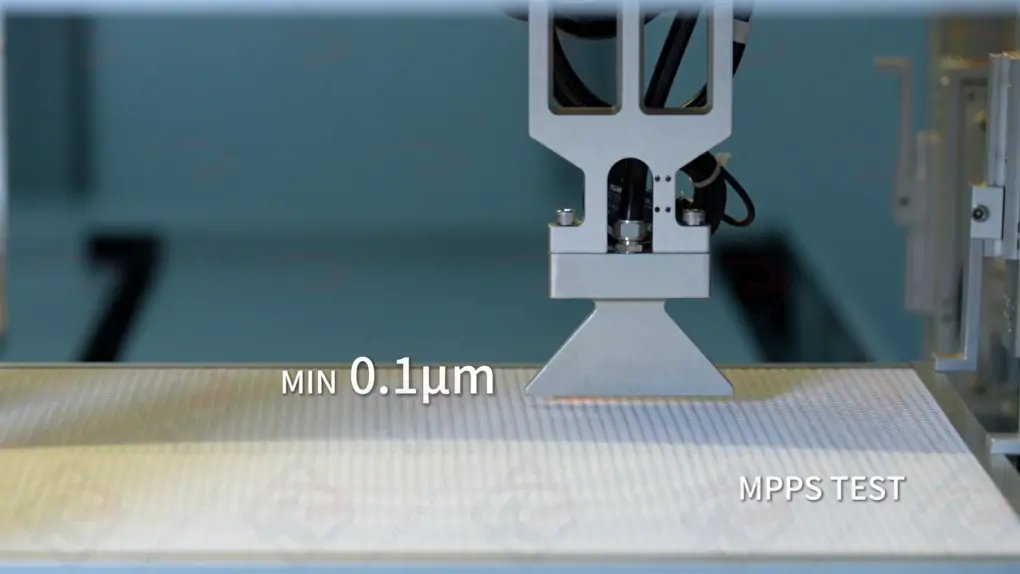
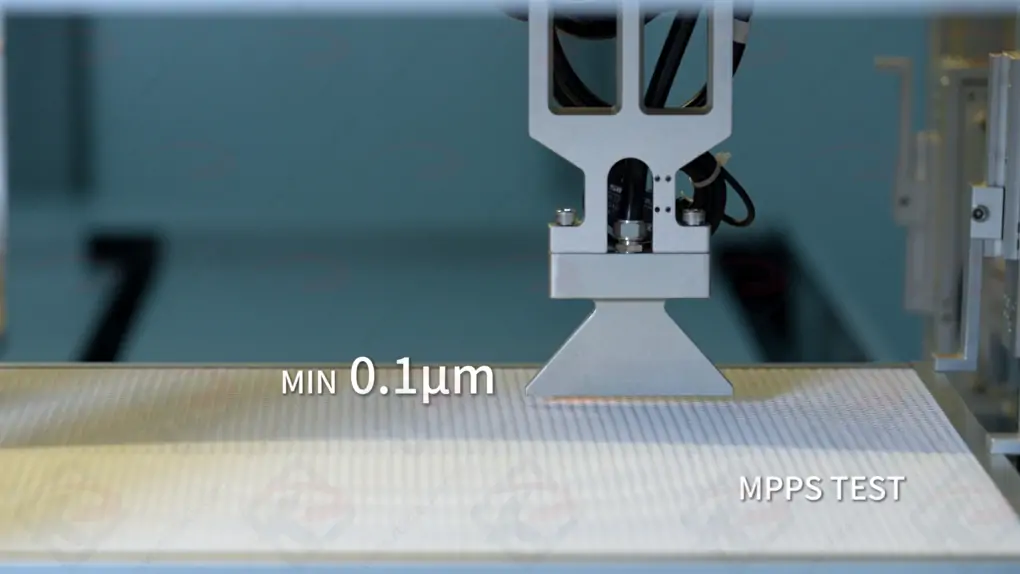
However, there is a particle size range between these mechanisms where capture efficiency reaches its lowest point. This is the Most Penetrating Particle Size. For most HEPA filters, MPPS typically falls between 0.1 and 0.3 microns, depending on media structure and airflow conditions. If a filter can achieve high efficiency at this most difficult particle size, it will perform even better for both larger and smaller particles. This is why MPPS is the critical benchmark.
MPPS and EN1822 Classification
According to EN 1822, HEPA filters must be classified based on efficiency at MPPS. For example:
- H13 ≥ 99.95% at MPPS
- H14 ≥ 99.995% at MPPS
This means the filter is tested under its most challenging condition. Efficiency claims based on other particle sizes can be misleading. True H14 performance must be verified at MPPS. The EN1822 standard also requires individual leak scanning to ensure the entire filter surface meets the specified efficiency level.
What an MPPS Test Report Actually Proves
An authentic MPPS test report demonstrates three critical things:
- It confirms the filter’s real minimum efficiency, not an average value.
- It verifies that the filter structure and sealing integrity are uniform across the entire surface. EN1822 requires individual scanning to detect micro-leaks.
- It validates the relationship between airflow and resistance at the most challenging filtration condition.
In other words, MPPS testing proves the filter’s true capability under worst-case particle penetration. Without MPPS verification, efficiency claims are incomplete.
Why Many Suppliers Do Not Perform MPPS Testing
MPPS testing requires specialized aerosol generation equipment, particle detection systems, and calibrated measurement instruments. The investment cost is high. The operation also requires trained technicians and controlled testing environments. For this reason, many suppliers rely on media supplier data sheets or theoretical calculations rather than conducting full MPPS-based testing on finished filters.
Especially in developing manufacturing markets, only a limited number of factories are equipped with dedicated MPPS testing systems. Without such equipment, H14 classification cannot be fully verified according to EN1822.
Manufacturer Capability as a Quality Indicator
From a buyer’s perspective, the ability of a manufacturer to perform MPPS testing internally is a strong indicator of technical level. It reflects:
- Commitment to EN1822 compliance
- Control over production consistency
- Understanding of airflow-resistance balance
- Investment in quality assurance infrastructure
MPPS testing is not merely a laboratory procedure. It represents the difference between theoretical efficiency and verified performance. When evaluating HEPA filter suppliers, requesting MPPS test documentation demonstrates professionalism and should be provided at no additional cost.
In an industry where efficiency labels are common, MPPS verification distinguishes true manufacturers from simple assemblers.