Why More Airflow Doesn't Mean a Cleaner Cleanroom
Why "More Air" Is Not Always Better
Most cleanroom owners believe that the stronger the airflow, the cleaner the room. In reality, this is one of the most common and costly misconceptions in cleanroom management.
A cleanroom is not judged by airflow strength, but by the concentration of airborne particles. The true goal is not to move as much air as possible, but to control particles effectively through optimal filtration, stable airflow patterns, pressure balance, and efficient system operation.
In short, A cleanroom doesn't need the strongest airflow. It needs the right airflow.
Too little airflow fails to remove particles effectively. Too much airflow creates new problems: turbulence, particle re-suspension, higher filter resistance, excessive energy consumption, and reduced filter lifespan.

What Happens When Cleanroom Airflow Is Too High?
Excessive airflow often leads to several hidden issues that hurt both cleanliness and operating costs:
- Particle Re-suspension: Instead of smoothly carrying particles to the return vents, overly strong or unstable airflow creates turbulence. This disturbs settled particles on floors, equipment, and garments, causing them to become airborne again.
- Rapid Increase in Filter Pressure Drop: Higher air velocity significantly raises resistance across filters. Pre-filters and medium-efficiency filters clog faster, while HEPA filters experience greater stress.
- Sharp Rise in Energy Consumption: Fan power consumption increases dramatically with airflow volume. In many cleanrooms, air movement accounts for the largest share of energy use.
- System Instability: Excessive airflow can disrupt designed pressure cascades and make the system harder to control.
When airflow exceeds the optimal range (for example, unidirectional flow in ISO 5 areas exceeding 0.45 m/s significantly), you are often paying more for worse performance.

Case Study: ISO 5 Cleanroom Retrofit in a 12-Inch Wafer Packaging Facility
A 5,000 m² ISO 5 cleanroom in a 12-inch wafer packaging plant was experiencing high energy consumption, frequent fan failures, and rising maintenance costs.
Although the system appeared "powerful," detailed inspection revealed critical issues:
- Actual airflow was 40% higher than the design specification
- Pre-filter pressure drop had reached 300 Pa
- Fans were operating outside their high-efficiency range
- Significant energy was wasted on winter humidification
The retrofit focused on optimization rather than increasing capacity:
- Replaced high-resistance pre-filters and medium-efficiency filters with low-resistance, high-dust-holding alternatives
- Installed airflow monitoring and variable frequency drives (VFD)
- Added enthalpy control for intelligent humidification
- Upgraded to high-efficiency motors
Results after retrofit:
- Annual electricity consumption reduced from 9.8 million kWh to 6.2 million kWh (≈37% savings)
- Total annual energy cost savings (electricity + steam) exceeded RMB 3 million
- Filter replacement cycle nearly doubled
- Investment payback period: less than 10 months
This project clearly demonstrates that more airflow does not equal better performance. The best results come from matching airflow, filtration, and system efficiency.
Why Low-Resistance Air Filter Selection Matters
Air filters are not just consumables — they are one of the most critical factors affecting cleanroom performance, stability, and lifecycle cost.
A well-selected cleanroom filtration system should deliver:
- Low initial pressure drop
- Stable high filtration efficiency
- High dust-holding capacity
- Reliable sealing and structural integrity
- Long service life under actual operating conditions
In a typical cleanroom HVAC system, pre-filters, medium-efficiency filters, and HEPA/ULPA filters work as a team. If the upstream filters have high resistance or poor dust-holding capacity, the entire system suffers: fans work harder, energy costs rise, and HEPA filters are replaced more frequently.
For example, two F7–F9 bag filters with the same efficiency rating can differ by 50–80 Pa in initial pressure drop. Over a full year of continuous operation, this seemingly small difference translates into substantial electricity savings and longer filter life.
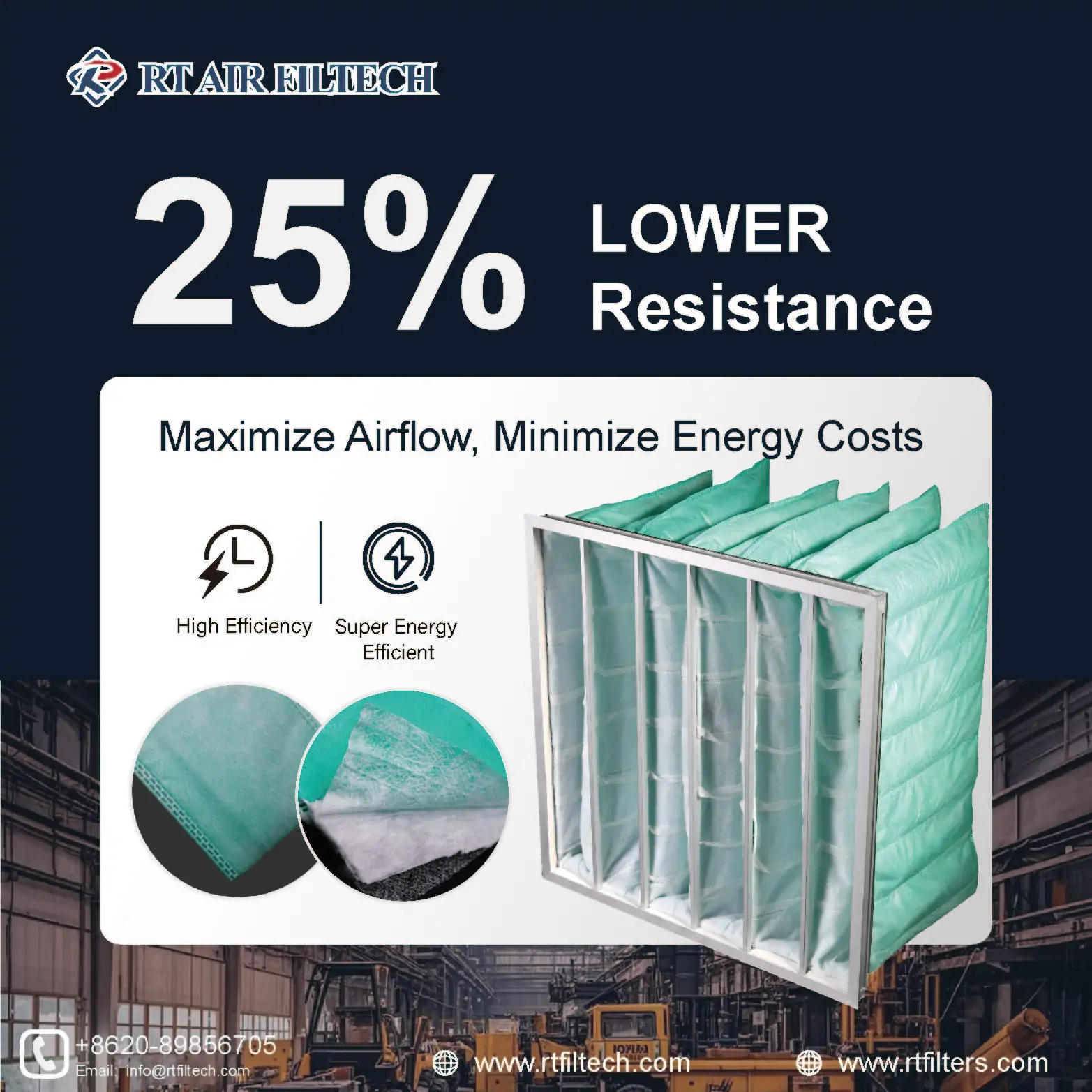
Choosing filters based solely on unit price or nominal efficiency is a false economy. The smartest decision is based on total lifecycle cost and system compatibility.
The Right Questions Cleanroom Operators Should Ask
- Is our actual airflow higher than the design requirement?
- Are our filters operating within their optimal airflow range
- Is the current pressure drop unnecessarily high?
- Are the fans running in their high-efficiency zone?
- Can we achieve the same cleanliness with better filtration and lower energy use?
RT Air Filtech Cleanroom Filtration Solutions
At RT Air Filtech, we specialize in helping high-tech manufacturers achieve stable cleanliness with lower operating costs.
Our cleanroom filtration products include pre-filters, medium-efficiency pocket and panel filters, high-performance HEPA filters, and filter material. They are engineered for low resistance, high dust capacity, and long service life.
Whether you are designing a new cleanroom or optimizing an existing facility, we provide not only high-quality filters but also professional system analysis and optimization recommendations.
Contact RT Air Filtech today to discuss your specific requirements and discover how the right filtration strategy can improve both cleanliness and profitability.