Why Same Size HEPA Filters Have Different Airflow?
Why Same Size HEPA Filters Have Different Airflow?
One of the most common questions in the air filtration industry is surprisingly simple: If two HEPA filters have the same size, why is their airflow different?
For example, two filters both labeled 610×610×150 mm may show rated airflow values such as 600 m³/h, 1000 m³/h, or even 2000 m³/h. To many buyers, this appears inconsistent or even incorrect.
However, the explanation is purely technical. External dimensions do not determine airflow capacity. Internal structure does. Understanding this principle is essential when selecting H13 or H14 HEPA filters for HVAC systems, cleanrooms, or pharmaceutical environments.
Airflow Is Determined by Effective Filtration Area
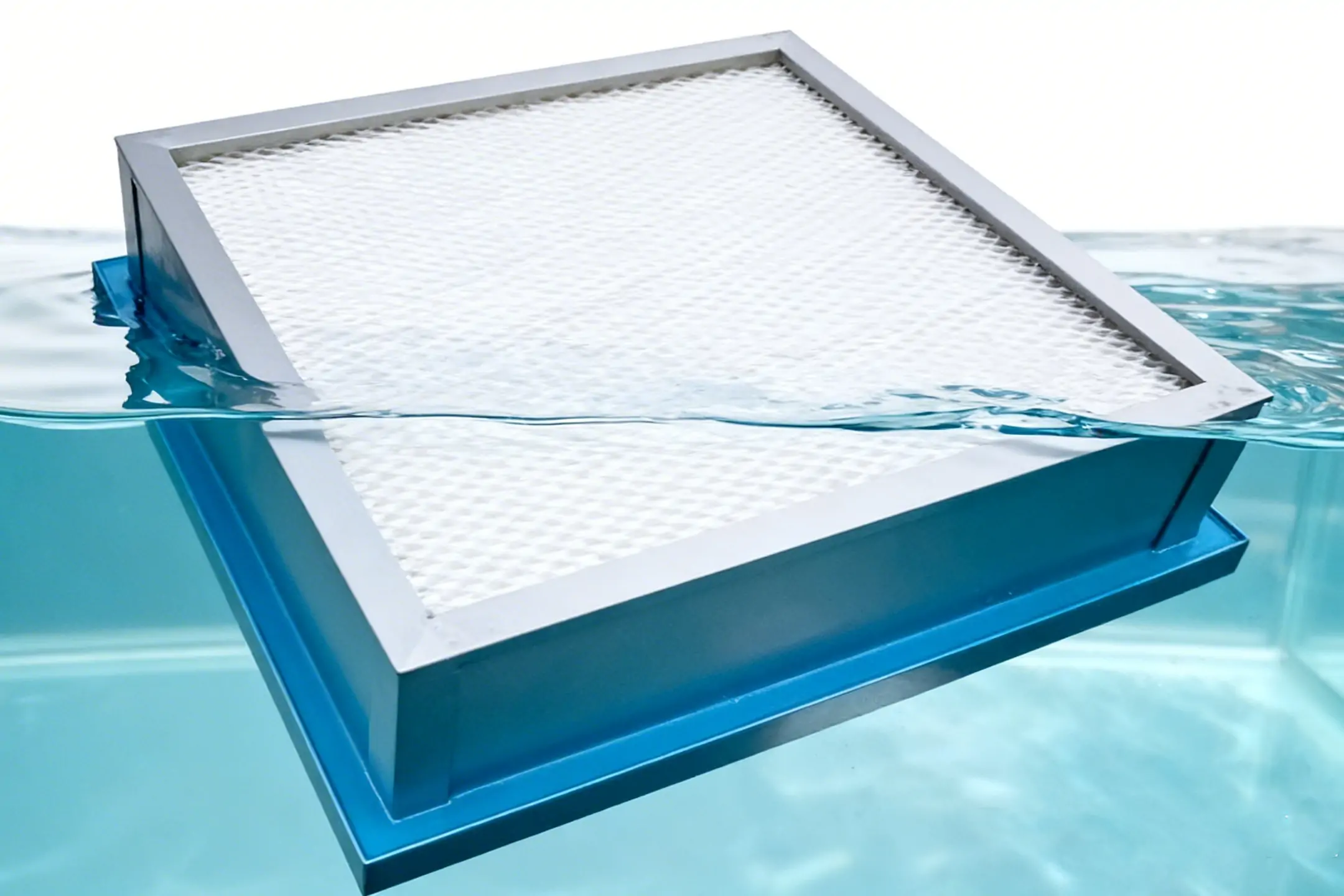
The first and most important factor is the effective media area. A HEPA filter’s airflow capacity depends on how much filtration surface is available inside the frame. The more surface area, the lower the air velocity per unit area, and the lower the pressure drop at a given airflow. Two filters with identical external dimensions can have very different internal pleat densities.
- The mini pleated HEPA filter typically has more closely spaced pleats created using hot-melt separator technology. This design significantly increases the effective filtration area.
- The traditional deep pleated HEPA filter, often constructed with aluminum separators, usually contains fewer pleats and therefore less total media area.
Less media area results in higher resistance at the same airflow, meaning the rated airflow must be lower to maintain acceptable pressure drop. The outer size remains the same. The internal surface area does not.

Structural Design Changes Performance
Another major factor is structural configuration. Some HEPA filters are standalone filter elements. Others are integrated into disposable units with built-in housing.
In a disposable HEPA filter unit, part of the depth is occupied by the metal casing and support structure. This reduces the available internal volume for pleated media. As a result, even if two products share identical outer dimensions, the internal filtration section may be smaller in the integrated unit. Reduced media area leads directly to reduced airflow capacity. This is why comparing airflow based solely on external size can be misleading.
Pressure Drop Limits Define Rated Airflow
Rated airflow is not just about how much air can physically pass through a filter. It is defined by acceptable initial pressure drop.
Manufacturers design HEPA filters to operate within specific resistance limits. If airflow is increased beyond the optimal range, pressure drop rises significantly, leading to:
- Higher energy consumption
- Reduced system efficiency
- Shortened filter lifespan
Therefore, airflow ratings are determined by balancing surface area and resistance to maintain stable system operation. Two filters with different internal designs will reach their resistance limits at different airflow values, even if their external dimensions are identical.
Efficiency Class Does Not Define Airflow
Another common misunderstanding is assuming that a higher efficiency grade automatically means lower airflow. According to EN 1822, efficiency classification, such as H13 or H14, is based on particle capture performance at MPPS, not airflow capacity. Airflow depends primarily on structural design and media surface area, not efficiency grade alone.
An H14 mini pleated HEPA filter can sometimes provide higher airflow than an H13 deep pleated filter of the same size, simply due to structural differences. Efficiency and airflow are related to media characteristics, but they are not interchangeable concepts.
Why This Matters in Real Projects
For HVAC contractors, duct manufacturers, and cleanroom designers, misunderstanding airflow differences can result in:
- Incorrect system balancing
- Unexpected pressure drop
- Overloaded fans
- Installation mismatches
When selecting HEPA filters, always start with the required airflow and system resistance parameters, rather than considering only the frame size. External size ensures compatibility with installation space. Internal structure determines performance.
Manufacturer Perspective
As a professional HEPA filter manufacturer, we design airflow capacity based on:
- Pleat density
- Media specification
- Structural depth
- Pressure drop requirements
- Application environment
Understanding why airflow differs is only half of the solution. The more important question for buyers is this: How can you ensure the airflow you order is the airflow you actually receive?
At the RT Air Filtech manufacturing facility, airflow performance is verified, not estimated.
Every HEPA filter is designed based on the required airflow and acceptable initial pressure drop. During production, pleat density and media surface area are calculated to match the specified airflow target. However, calculation alone is not enough. Final verification is performed through efficiency and resistance testing in accordance with EN 1822 requirements. Using MPPS-based testing equipment, we measure both filtration efficiency and pressure drop to confirm that the filter operates within its designed airflow range.
This is particularly important for projects requiring precise airflow control, such as pharmaceutical cleanrooms, hospital environments, or terminal HVAC installations. Without proper testing, two filters with identical dimensions may behave very differently in actual operation.
By combining structural design optimization with MPPS efficiency verification, we ensure that the airflow rating provided in our specification matches real performance. If a specific airflow value is required, such as 600 m³/h or 1000 m³/h for a 610×610×150 configuration, we can design and test accordingly before delivery.