Common Issues with Paint Booth Pocket Filters
Optimize Your Paint Room Filtration System
Advanced multi-stage filtration solutions to ensure perfect paint finishes and efficient operations
Multi-Stage Filtration System
The air intake filtration system of the spray paint room usually adopts multi-stage filtration to achieve a balance between high dust holding capacity and high efficiency.
In some situations where there are extremely high requirements for coating quality, such as spraying in high-end automobiles or aerospace fields, sub-high efficiency filters (E10/E11) may be considered at the end of the air supply system.
Primary Filtration
Typically, G3 or G4 grade pre filters are used to capture large particles of dust and impurities, protecting the medium-efficiency filters.
Medium-Efficiency Filtration
Typically, bag filters of F5 to F8 grades are used to capture fine particles as small as 1 micron, which is crucial for ensuring air cleanliness. This is the core part of the filtration system in the paint room.
Ceiling Filter
A dedicated ceiling filter is also installed at the air inlet or the supply air ceiling. Its main function is to purify the final air and evenly distribute the air to prevent secondary pollution.
Why Are Pocket Air Filters Always Clogging?
Paint booth pocket filters are crucial for ensuring air quality and paint finish, but they are also often the source of inefficiency. Filter clogging is the most common issue. It restricts airflow and increases resistance, affecting the air flow rate and uniformity in the spray booth. In some areas, this can cause product vortices or dead spots, seriously impacting paint quality.
Improper Selection, Imbalance Between Dust Holding Capacity and Filter Grade
- Insufficient Dust Holding Capacity: A filter's dust holding capacity is the key factor determining its service life. If the thickness, density, or folding method of the filter material is not well-designed, its capacity to hold paint overspray is poor, and the filter will clog quickly
- Mismatched Filter Grade: If a filter with an excessively high grade is selected (e.g., using F7 where F5 should be used), the filter's pore size will be smaller, making it more prone to rapid clogging from a large amount of overspray.
- Poor Progressive Density Structure: High-quality filters use a progressive density structure where fibers on the air inlet side are sparse and on the outlet side are dense. This structure allows large particles to be captured first, with smaller particles entering the inner layer, fully utilizing the filter's space. Without this design, particles accumulate on the surface, causing rapid clogging.
Improper Installation, Leading to a Drop in Efficiency
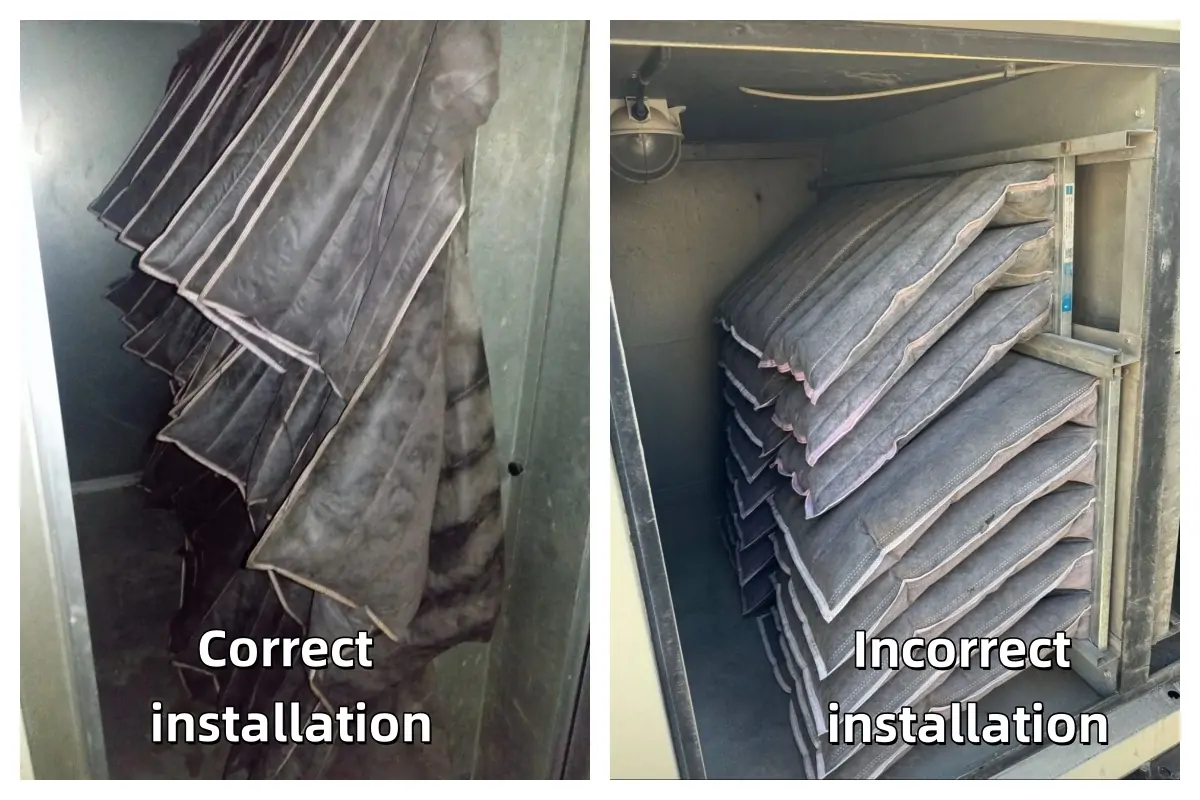
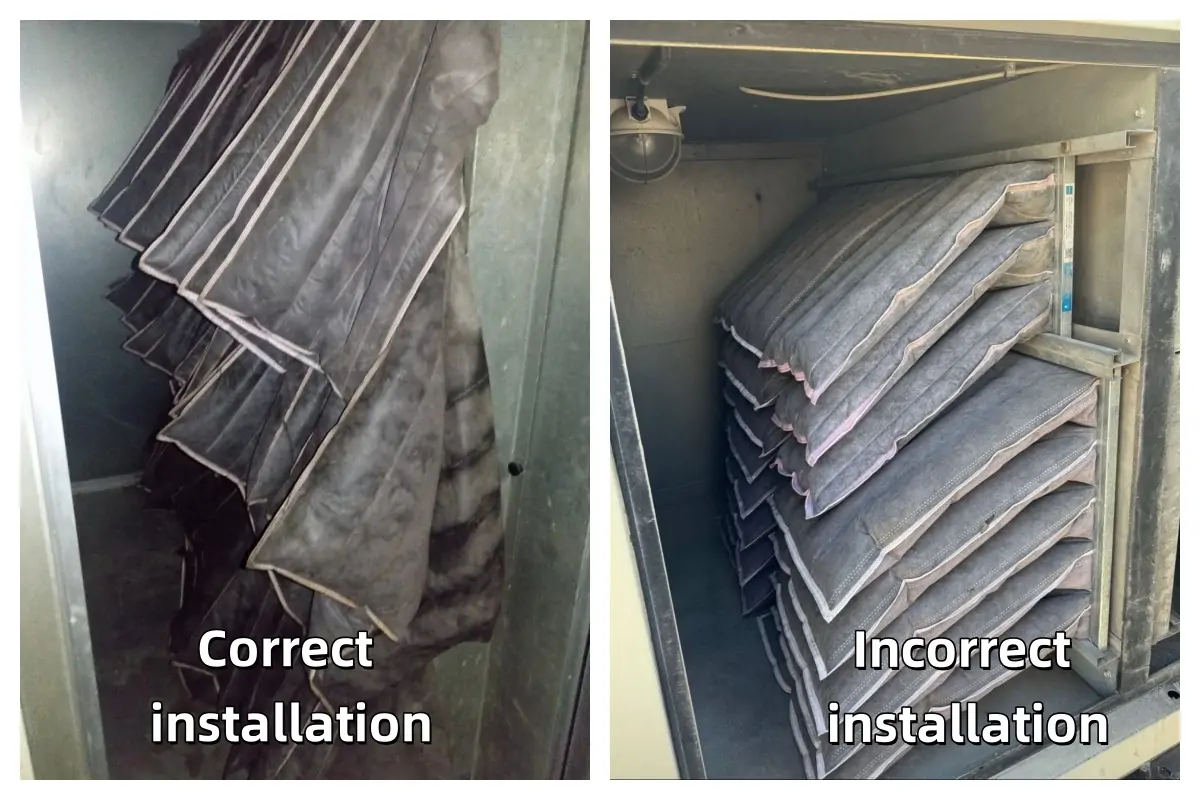
- Incorrect Pocket Direction: The pockets of a bag filter should be installed vertically downward to ensure air flows evenly through each pocket and fully utilizes the filtration area. If the pockets are placed horizontally, air tends to pass only through the upper pockets, causing them to clog prematurely and increasing air resistance.
- Poor Sealing: The sealing strip (gasket) is key to preventing air short circuits. If it's missing, damaged, or improperly installed, air will bypass the filter through the gap, and the filter's seal is located at the back of the frame material for embedded installation.
- Incorrect Installation Location: Some manufacturers may install filters in the wrong position to save costs, leading to uneven air distribution and premature saturation of some bags.
Inadequate Process and Environmental Control
- High Volume of Paint Overspray: Poor atomization or unskilled painting techniques can generate a large amount of overspray, increasing the filter's load.
- Lack of Primary Filtration: A paint booth's air intake system is typically multi-stage. Without a primary filter (like G3 or G4 grade) to capture large particles, all the load is placed on the medium-efficiency pocket filter, causing it to fail quickly.
Neglected Maintenance and Untimely Replacement
Filters are consumables that require regular replacement. Without a replacement schedule based on pressure drop monitoring, an expired filter will inevitably become saturated and clog, increasing maintenance costs and downtime.