Paint Stop Filter Quality Revealed! How to choose a quality fiberglass filter?
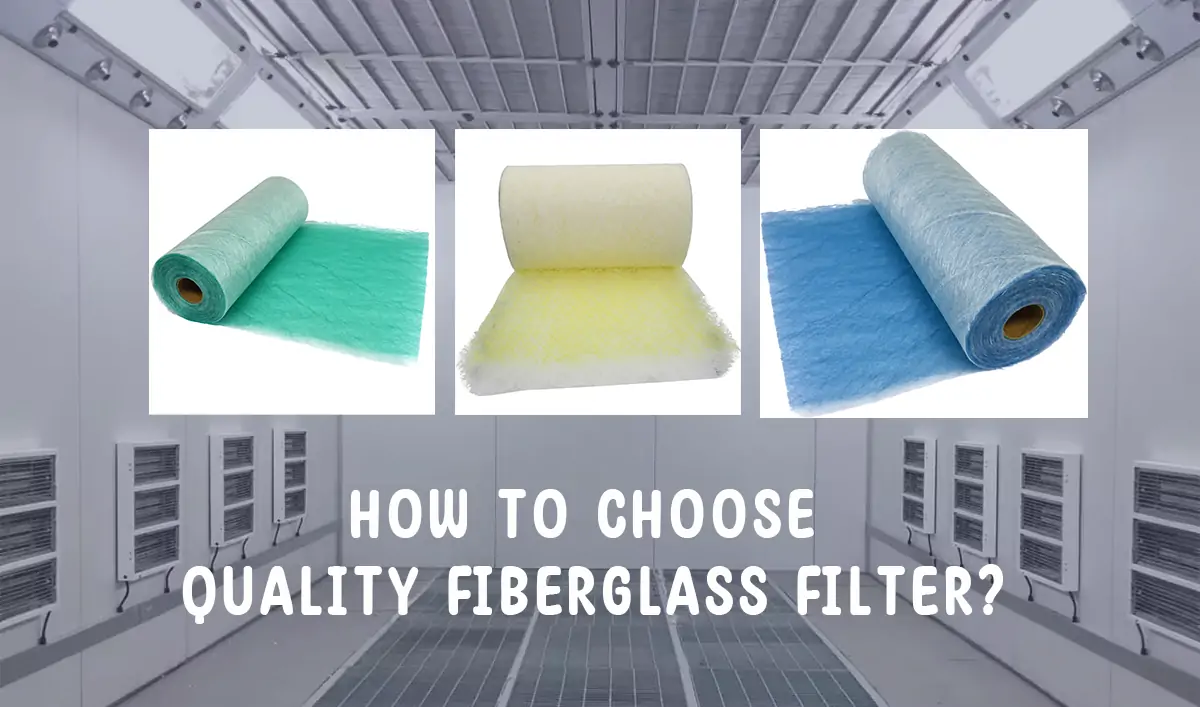
Glass fiber filters are made by heating and melting glass beads and then drawing them into a filamentary mesh structure. The process of making fiberglass filters is not difficult, but there are very few that do it well, and some manufacturers take advantage of low prices to sell low-quality products. Let's delve into the common quality issues that can arise in fiberglass filters.
1. Lack of resilience
It is well known that the resilience of fiberglass media is in fact directly related to the dust holding capacity, like ceiling filter and pre-filter cotton. Insufficient resilience means a smaller filtering surface area, resulting in reduced dust holding capacity. Fiberglass media is the paint capacity that is usually used in the painting industry.
According to Brownian motion, the greater the surface area of fibers per unit volume, the greater the ability to adsorb dust in a slow and complex flow environment. Highly fluffy glass fibers can effectively extend the time to reach saturation (maximum dust holding capacity), preventing dust particles from accumulating too quickly on the filter surface to form clogs and allowing dust to penetrate deeper into the filter.
The cause of the lack of elasticity is related to the temperature and humidity, and the storage environment is too humid, which will also cause the fiber elasticity to deteriorate. So, in long-time transportation extrusion shipping, if the manufacturer's production machine is not advanced enough, it really can't make fiberglass media that can be transported or stored for a long time.
RT Air Filtech's fiberglass media has good resilience because we have brought in a new drying machine, the temperature difference of the whole oven is within 0.5 degrees, and the uniformity of temperature can ensure the uniformity of the resilience.
Watch our YouTube video to see the resilience of our products!
//youtu.be/RZNio5ZzgUc
2. Fiber debris and flying
Fibers are too brittle to cause breakage so they slag. In the heat treatment of glass fibers, when the temperature rises rapidly, the thermal expansion of the outer layer of the fiber is faster than the inner layer, which leads to tensile stress inside the fiber. When this tensile stress exceeds the strength limit of the glass fiber, microcracks appear, making the fiber brittle.
When guests open the bag, there will be debris that needs to be cleaned up manually. Fiber debris can not be 100% solved with the current level of the industry. However, we can minimize it, which is a test of our ovens and drawers.
RT Air Filtech has responded to this problem with new equipment such as the one mentioned above, by improving the drying process: lowering the temperature, and reducing the drying speed, which reduces the productivity of a single line but guarantees quality. Besides, we have 15 production lines, which does not affect our production schedule.
In the past, after receiving feedback from customers, RT Air Filtech has actively sought solutions to the problem. Although fiber slubs and flyaways are not extremely serious quality issues, they do demonstrate our dedication to product quality.
3. Fiber delamination and delamination, insufficient weight problem
The main reason for fiber delamination is that the glue inside the top is insufficient. In some factories in the production process, usually used while pulling the fiber while spraying the color paste, this operation is likely to lead to the green part of the spray color is not uniform, and the glue will be diluted.
To simplify the workflow and reduce costs, some factories mix the glue ratio at once. However, RT Air Filtech adopts a different strategy, after ensuring that the product reaches the full grammage, it will make two glue blends to increase the concentration of the glue and enhance the adhesion between the fiber strands, thus effectively reducing the phenomenon of fiber strand fall to a certain extent and ensuring that the product meets the grammage requirement.
4. Formaldehyde odor
The source of formaldehyde is glue. Fiberglass filters sprayed with glue are dried and cured in an oven. The glue releases formaldehyde and other gases at high temperatures. If the product is packaged before it has cooled completely, the formaldehyde gas remains inside, resulting in a strong odor when the package is opened. This can significantly impact the user experience. RT Air Filtech has always been concerned about the user's experience, and we have made it a rule to pack the bags after they have cooled down.
Through an in-depth analysis of common manufacturing defects in fiberglass filters, we can see that the quality of the fiberglass filter is closely related to the production process, RT Air Filtech with advanced equipment and strict quality control, and the production of high-quality fiberglass filters.
When choosing a floor filter product, you should not only pay attention to the price but also the quality of the product. RT Air Filtech always insists on quality as the foundation to provide customers with safe and reliable filtration solutions.
Contact us for a free sample today!