Why Leak-Free HEPA Filters Can Still Fail MPPS Efficiency Testing
In today's HEPA filter industry, more manufacturers are investing in PAO leak testing systems to improve product reliability and customer confidence. However, having leak testing equipment does not necessarily mean a manufacturer performs complete HEPA validation on every filter. While PAO scanning is widely used for leak detection and integrity testing, far fewer manufacturers are equipped with full MPPS efficiency testing systems due to the higher technical requirements, calibration standards, and testing costs involved. As a result, some HEPA filters may pass leak testing but still fail overall MPPS efficiency evaluation according to EN1822 and ISO 29463 standards.
Leak Testing Does Not Equal MPPS Efficiency Testing
In HEPA filter manufacturing, leak testing and MPPS efficiency testing are often confused, but they evaluate different aspects of filter performance. PAO/DOP leak testing is primarily used to identify local leakage points, such as frame leakage, sealant defects, or media damage, through aerosol scanning. A filter may pass leak testing if no significant local leakage is detected.

However, MPPS efficiency testing evaluates the overall filtration efficiency of the entire filter at the Most Penetrating Particle Size (MPPS), which is the most difficult particle size to capture. Even without detectable leakage, poor media quality, unstable pleat structure, or airflow distribution issues can still cause a HEPA filter to fail EN1822 overall efficiency requirements.
Why MPPS Efficiency Testing Is More Challenging
In many factories, PAO testing has already become common, but stable MPPS testing capability is still relatively limited. In addition to aerosol generation and leak scanning, MPPS testing relies on highly accurate upstream and downstream particle counting, airflow stability, environmental control, and regular calibration of particle counters. In some cases, filters from the same production batch may show noticeably different MPPS results.

For this reason, many manufacturers are equipped with basic leak testing systems, while far fewer are capable of performing stable and repeatable MPPS efficiency testing for every HEPA filter. This is also why individual test reports and traceability systems are becoming increasingly important in critical cleanroom applications.
Low-Quality Filter Media Can Still Cause Efficiency Failure
Even when no detectable leakage is found during PAO scanning, the filter media itself may still fail to achieve the required MPPS efficiency. HEPA filtration performance depends heavily on the fiber structure, density uniformity, and stability of the filter media. Low-quality or unstable media may appear intact during leak testing but still allow excessive particle penetration at the Most Penetrating Particle Size (MPPS).

In some cases, filters using lower-grade media can pass local leak detection while failing overall EN1822 efficiency requirements. This is one of the main reasons why MPPS testing remains critical for H13 and H14 HEPA filters.
Pleat Structure and Airflow Distribution Also Affect MPPS Efficiency
Even when the filter media itself meets HEPA requirements, improper pleat design or unstable airflow distribution can still reduce overall MPPS efficiency. Uneven pleat spacing, excessive pleat compression, or poor airflow balance may create localized high-velocity areas, increasing particle penetration at the Most Penetrating Particle Size.

In these situations, a filter may remain leak-free during PAO scanning yet still fail EN1822 overall efficiency testing due to unstable filtration performance across the filter surface.
Why Individual Testing and Traceability Matter
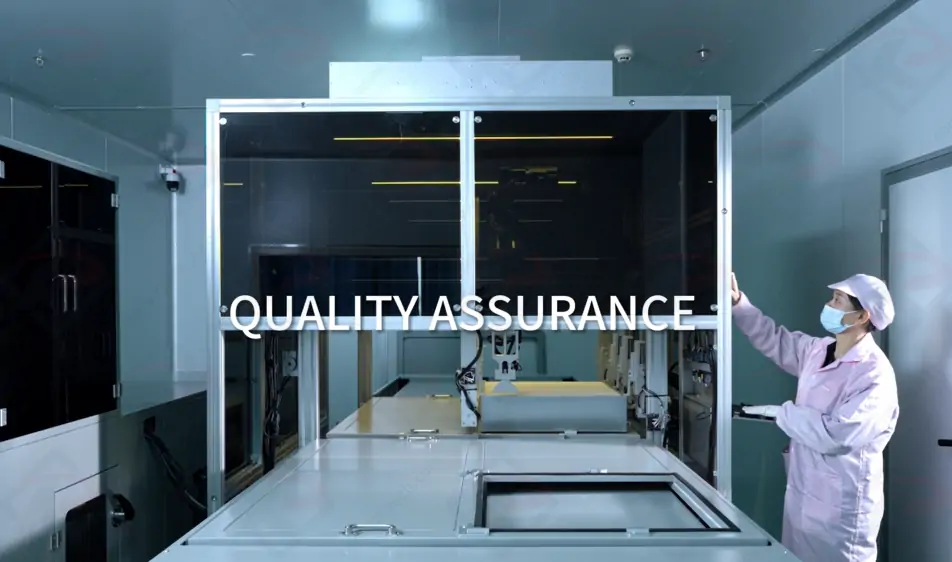
More HEPA manufacturers are investing in complete MPPS testing capabilities rather than relying on leak testing alone. To ensure stable EN1822 performance, RT Air Filtech is equipped with a complete MPPS testing system designed for H13 and H14 HEPA filter evaluation. The system uses Lighthouse 0.1μm particle counters and performs airflow, resistance, and efficiency testing under controlled conditions.
Each HEPA filter is individually tested and assigned a unique serial number with a corresponding test report to ensure traceable and reliable filtration performance for cleanroom applications.
Contact us for detailed specifications and EN1822 testing documentation.