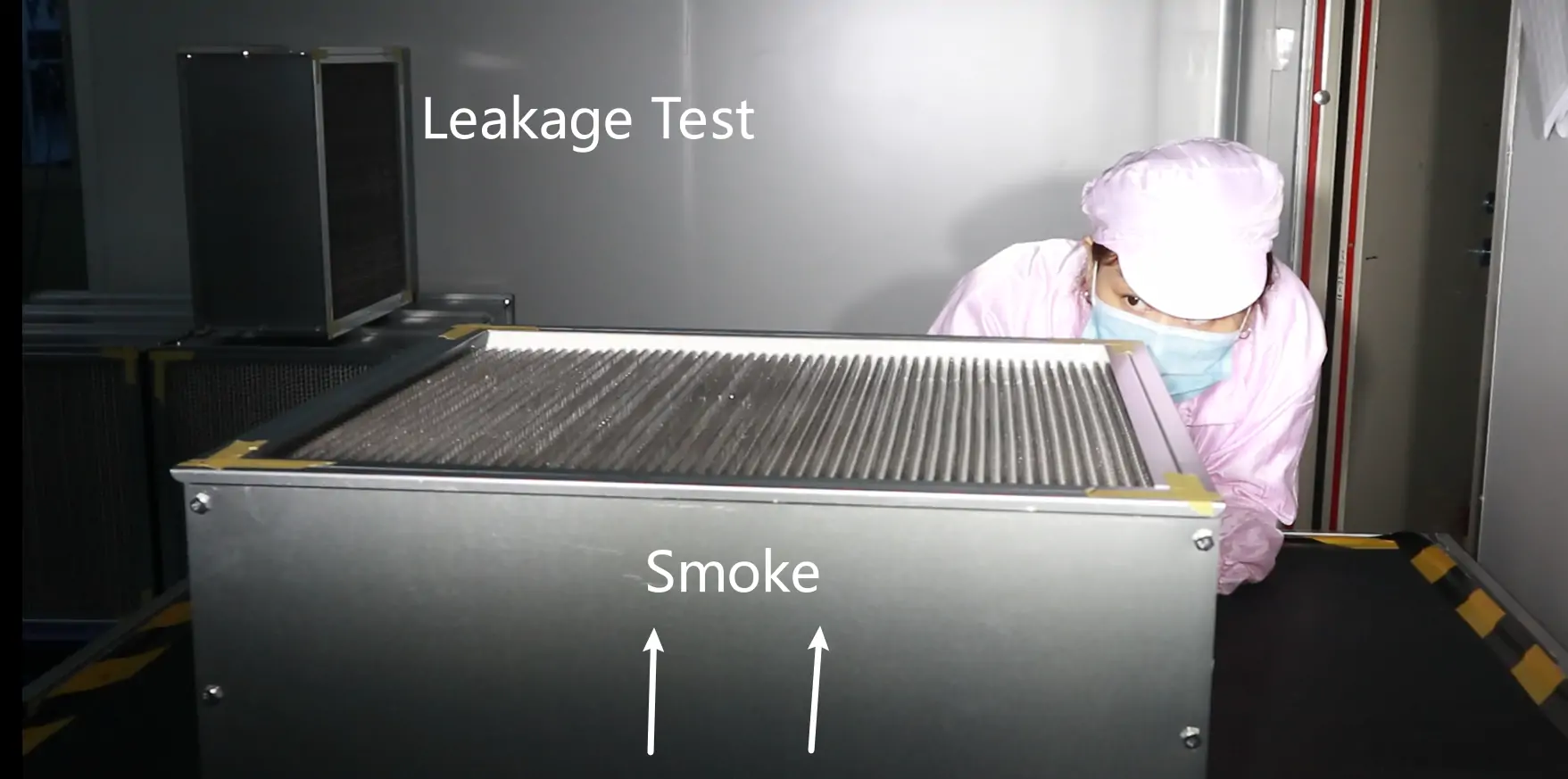
DOP Leak Testing in GMP Pharmaceutical Enterprises
Principles and Technical Characteristics of DOP Leak Testing
-
The Technical Core of DOP Leak Testing
This method uses a PAO (polyalphaolefin) generator to generate dust upstream of the filter, and a photometer to detect aerosol concentrations upstream and downstream of the filter to determine if a leak exists. The need for dust generation lies in the fact that the concentration of dust particles upstream of the high-efficiency filter is usually low, and it is difficult to find small leaks if only a particle counter is used to detect them without generating dust, and supplemental dust generation can make the leakage phenomenon obvious and easy to identify. In practice, the PAO generator can be divided into two types of hot and cold generation: hot generator using the principle of evaporation and condensation, the aerosol particles being atomised with a heater to evaporate and condense into a mist of about 0.3μm DOP into the air duct under specific conditions, with a particle size distribution in the range of 0.1 to 0.3μm; cold generator is the use of compressed air bubbles in a liquid drum, through the Laskin spray tube The cold generator uses compressed air to blow bubbles in the liquid, which are splashed through the Laskin nozzle to produce a polydispersed DOP aerosol, with a maximum particle size distribution of about 0.65 μm.
-
Photometers vs. Particle Counters
The key difference between these two instruments is that the particle counter measures the particle number distribution (in ‘particles/L’), while the photometer measures the particle mass concentration (in ‘mg/L’). Since particle size and weight are in a cubic relationship, large particle size particles account for a larger proportion of the mass concentration distribution, so the two instruments will get different results in the detection of filter efficiency. Although the sensitivity and accuracy of the photometer is slightly lower than the particle counter, it is sufficient for the H13 and below HEPA filters commonly used in pharmaceutical companies, and is more economical and convenient; while the leakage detection of ULPA filters requires the use of a more sensitive particle counter.
-
Technical Advantages of DOP Leak Testing
1. high sensitivity, capable of detecting tiny leakage points and ensuring that the sealing of the filter meets the highest standards;
2. real-time monitoring capability, through the real-time data of the aerosol photometer, inspectors can quickly grasp the filter performance status;
3. Wide applicability, applicable to many types of high-efficiency filters, especially to meet the strict requirements of pharmaceutical workshops for clean environments.
These features make it the preferred method for pharmaceutical companies to verify the performance of cleanrooms in GMP environment.
GMP Cleanroom Requirements and Leakage Standards
Cleanliness classifications reflect the strict hierarchy of microbiological and particulate control in GMP.
Class A: As a high-risk operation area, applies to the filling area, the area for placing stoppered drums and open packaging containers in direct contact with aseptic preparations, as well as the area for aseptic assembly or joining operations, and the environmental status must be maintained with a unidirectional flow operating table (hood), with the wind speed controlled at 0.36-0.54m/s (guideline value).
Class B: As aseptic preparation and filling and other Class A clean areas located in the background environment, the requirements and Class A area in the temperature and humidity parameters to maintain consistency, but the number of air changes and differential pressure have different provisions.
Class C and D: apply to the less important operation steps in the production of aseptic drugs, and the requirements of each parameter are in decreasing order.
|
Class |
Application | Temp. (°C) | RH (%) |
Air Changes (times/h) |
Pressure Diff. (Pa) | Airflow (m/s) | Filter Efficiency (%) |
|
A |
High-risk aseptic operations |
20-24 |
45-60 |
- |
≥10 (adjacent zones) |
0.36-0.54(Unidirectional flow) |
>99.97 |
|
B |
Class A background |
20-24 |
45-60 |
≥25 |
≥10 (vs. external) |
- |
>99.97 |
|
C |
Low-risk aseptic operation |
20-24 |
45-60 |
≥25 |
≥10 (vs. external) |
- |
>99.97 |
|
D |
General operation |
18-26 |
45-60 |
≥15 |
≥10 (vs. external) 10(相对室外) |
- |
For pharmaceutical companies, understanding and implementing these requirements is the basis for implementing DOP leak testing. Only by placing leak testing activities within the overall framework of GMP can the validity and compliance of test results be ensured and the quality of the pharmaceutical manufacturing environment be truly assured. This also reflects the concept of 'Quality by Designa' (QbD) in modern pharmaceutical production quality management, i.e., to guarantee the quality of the final product through scientific design and strict control.
Applications and Case Studies in Pharmaceutical Manufacturing
DOP leak detection method has a wide range of application scenarios in pharmaceutical enterprises, from cleanroom validation to daily monitoring, from aseptic production to quality control, this method has become an important technical means to ensure that the pharmaceutical production environment meets the requirements of GMP. Different application scenarios have different requirements and implementation methods for leak detection. Understanding these application scenarios will help pharmaceutical companies make more effective use of DOP leak detection technology, optimise resource allocation and improve quality management.
-
Environmental Control of Sterile Preparation Manufacturing
Sterile preparation manufacturing is the most important application area for DOP leak detection methods, especially in the manufacture of sterile products such as injectables and ophthalmic preparations. In this type of production, the integrity of high efficiency filters in class A clean areas (e.g. filling areas) is directly related to the level of product sterility assurance. A case study of a biopharmaceutical company shows that before conducting a simulated filling test of culture media, a comprehensive DOP leakage check must be performed on the high-efficiency filter in the A-class area to confirm that the leakage rate is ≤0.01%, which is a prerequisite for the success of the simulation test. In practice, laminar flow benches, as typical equipment in the A-class area, need to pay special attention to the sealing of their high-efficiency filters at the joints between the filter media and the frame, which are prone to tiny cracks due to transport, vibration or long-term use, leading to particle leakage.
Closed aseptic production equipment such as isolators and glove boxes also require stringent DOP leak detection. GMP states that lower air velocities (below the conventional Class A of 0.36-0.54m/s) may be used in closed isolation manipulators or gloveboxes, but the integrity of the filters must be demonstrated by DOP leak testing. This type of equipment is unique in that it has a small internal space and complex airflow patterns, and leak testing requires specialised adapters and sampling heads to ensure that all potential leak points can be covered. In the case of a pharmaceutical company, the HEPA filter inside the isolator was found to have a localised leakage rate that exceeded the standard during regular leakage testing. The leakage rate was found to be caused by the ageing of the sealing gaskets, which were replaced and the leakage rate was restored to normal, thus avoiding the risk of potential product contamination.
-
Cleanliness Assurance for Non-Aseptic Formulation Manufacturing
While the cleanliness requirements for non-sterile formulation manufacturing are lower than those for aseptic formulations, the integrity of the HEPA filter is equally important. In class C and D clean areas for oral solid preparations, topical preparations, etc., leakage of HEPA filters can lead to excessive particle counts, affecting product quality and stability.The application of DOP leakage checking in such areas is characterised by a relatively long period of time (usually 1-2 years), but the standards are equally stringent (leakage rate ≤ 0.01%). The experience of a pharmaceutical plant shows that regular DOP leak detection and repair of leaks in the high-efficiency filter frame seals can increase the cleanroom particle pass rate from 95% to 99.8%, significantly improving the stability of environmental quality.
Some key processes in the production of APIs also require the application of DOP leak detection technology. In particular, the integrity of high efficiency filters is related to the microbiological and particulate control level in the processes of refining, crystallisation and dispensing of aseptic APIs. Since API production often involves corrosive gases or solvents, filter materials may be more susceptible to deterioration than in conventional formulation production, and therefore leak detection cycles may need to be shortened. An antibiotic API manufacturer has shown that reducing the leak detection cycle for HEPA filters in the crystallisation area from 12 months to 6 months has resulted in a 40% reduction in the number of incidents of product impurities exceeding standards, demonstrating the value of adapting the frequency of leak detection.
-
Filter Validation for Auxiliary Production Equipment
Drying tunnels and dry ovens are often overlooked but critical pieces of equipment in pharmaceutical manufacturing that are equipped with high-efficiency filters (HEPA) that can have a direct impact on product quality. The FDA has clearly stated that HEPA filters used in this type of equipment need to be included in the leak testing programme. In practice, the implementation of leak detection is often challenging due to the structural limitations of the equipment, requiring specialised test interfaces and adapters. In the case of a solid dosage plant, a drying tunnel HEPA filter was found to be leaking more than once during the annual leakage check. After analysing the sealing material was embrittled due to the long term high operating temperatures, the problem was solved by replacing the high temperature resistant gasket and adding cooling measures.
The overall leak detection of HVAC system is a typical scenario of large-scale application of DOP leak detection technology in pharmaceutical companies. The central air-conditioning system of a large pharmaceutical company may contain hundreds of high-efficiency filters distributed in different cleanliness levels, and leak detection requires systematic planning and coordination. In terms of implementation strategy, zoning and batch testing are usually adopted, combining the operating characteristics of the air-conditioning system and process production arrangements to minimise interference with normal production. A case study in a biopharmaceutical park shows that by optimising the leakage inspection routes and adopting multiple devices for parallel inspection, the leakage inspection time for more than 600 high-efficiency filters in the whole plant was compressed from two weeks to four days, which is a significant improvement in efficiency.
DOP Leak Detection Method Method Limitations and Considerations
Health and safety concerns are the main challenges facing traditional DOP leak detection methods. Dioctyl phthalate (DOP) has been used for nearly 40 years as an early aerosol source, but because of its suspected carcinogenicity, it has been abandoned by many pharmaceutical companies in favour of safer alternatives such as DOS (dioctyl sebacate, also known as DEHS) or PAO (polyalphaolefin). However, the industry still refers to this type of leak detection as the "DOP method", and in practice, attention should be paid to the safe use of chemicals.The FDA particularly emphasises that the aerosols used for leak detection should meet the physical and chemical requirements, and should not be used to cause microbial contamination or microbial growth. In practice, testers are required to wear protective masks and eye protection to ensure safe operation.
Operational complexity is also a practical challenge for DOP leak detection. The complete leak detection process includes system preparation, aerosol introduction, photometer calibration, scanning leak detection, result analysis and follow-up, each of which has strict technical requirements. For example, the upstream aerosol concentration needs to be adjusted to 10-20 μg/mL or 20-80 μg/L (varying slightly from standard to standard), the scanning speed should not exceed 5 cm/s, and the sampling head should be about 1 inch (2.54 cm) from the filter surface. These delicate operations require a high level of skill and experience on the part of the inspector, or else they can easily lead to misjudgment. In practice, many pharmaceutical companies choose to outsource leak testing to specialised organisations, such as one-stop HEPA filter leak testing service providers, to ensure the quality of testing.
As an important means of clean environment control in the pharmaceutical industry, DOP leak detection method, although it has certain limitations, is still evolving and improving through technological innovation and standard optimisation. Understanding these limitations and development trends will help pharmaceutical companies to apply the existing technology more scientifically, while preparing for future technological upgrades to continuously improve the quality management level of the clean environment and meet the increasingly stringent GMP requirements. This joint progress of technology and management is a solid foundation for safeguarding drug quality and serving patients' health.