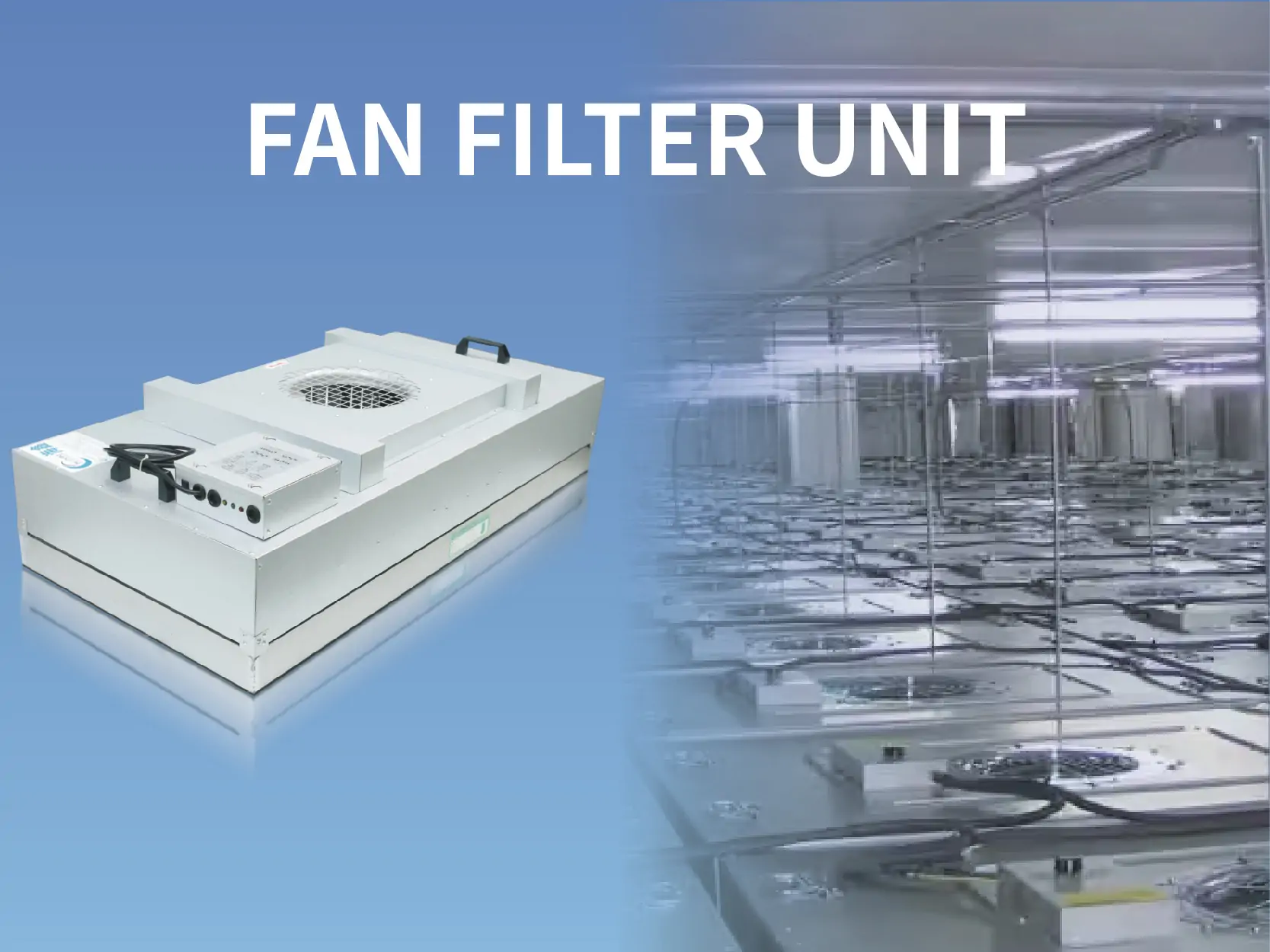
FFU vs Central AHU Air Supply for ISO 7 Cleanrooms
Choosing between a ceiling full of fan filter units (FFUs) and a central air handling unit (AHU) with ducted HEPA supply is one of the most consequential decisions in ISO 7 cleanroom design. On a layout drawing, both approaches can look like rows of filters in a ceiling. Operationally, financially, and in terms of long-term flexibility, they are different systems solving overlapping but not identical problems.
The useful question is not simply "Which one costs less?" nor "Which one is technically superior?" The real question is: which air supply architecture matches the cleanliness class, process risk, building constraints, operating schedule, and maintenance capability of this particular project? For an ISO 7 cleanroom, a fully populated FFU ceiling is often not the most economical or technically necessary choice. In many large-area, non-unidirectional ISO 7 applications, a central AHU with terminal HEPA filters delivers the required particle control at lower capital and operating cost. In other cases—retrofits, layout-flexible facilities, and local high-grade zones—FFU-based or hybrid designs are the better fit.
Quick Answer: FFU or AHU for ISO 7?
For a large-area ISO 7 cleanroom in a new building, a central AHU with ducted HEPA supply is usually the default starting point. ISO 7 is a non-unidirectional airflow class. Its particle limits are achieved through dilution ventilation with filtered air, not through the piston-like sweeping action of unidirectional flow. The main technical justification for a high-density FFU ceiling—maintaining unidirectional airflow for ISO 5 or tight ISO 6 conditions—does not apply to the bulk of an ISO 7 space.
FFU-first or high-coverage FFU designs make more sense when the project involves ISO 5 or airflow-sensitive ISO 6 zones, a retrofit with limited ceiling height or duct routing space, a production layout expected to change, or a staged expansion strategy. In large projects that combine ISO 7 background conditions with local ISO 5 or ISO 6 process areas, a hybrid design—AHU for the background, FFU for the critical zones—is frequently the most efficient allocation of capital and operating cost.
ISO 7 Is a Non-Unidirectional Class
ISO 14644-1 defines ISO 7 by particle concentration, not by airflow pattern. The limit is 352,000 particles ≥0.5 µm per cubic meter, alongside limits at 1 µm and 5 µm. The standard does not prescribe an air change rate; design practice does. For ISO 7, typical HEPA-filtered supply rates fall in the 30–60 air changes per hour (ACH) range, with higher values for rooms with heavy in-operation loads. HEPA ceiling coverage in ISO 7 is commonly around 10–15% of ceiling area, not the 80–100% coverage associated with ISO 5 unidirectional ceilings.
The airflow pattern is turbulent or non-unidirectional: ceiling HEPA terminals supply filtered air, low-wall returns extract it, and contaminants are diluted rather than swept away. In ISO 5, the goal is a near-piston-like downward flow that physically displaces particles from critical surfaces. In ISO 7, the goal is sufficient clean-air dilution, stable pressure cascades, and control of particle sources. A very high FFU coverage rate is not automatically "better" for ISO 7; it may add fan power and first cost without improving process-relevant particle control.
A common source of confusion is the old Federal Standard 209E "Class 10,000" label. The number does not imply a need for 10,000 ACH or anything close to it. It is a particle count classification, and the design response is an ACH rate calculated from particle generation, recovery requirements, and occupancy—typically in the tens, not the hundreds.
Table 1 summarizes the design logic across classes.
| Cleanroom class | Typical airflow pattern | Common FFU coverage (industry practice) | Typical ACH range | Common air supply approach |
|---|---|---|---|---|
| ISO 5 | Unidirectional | High, often 80–100% | 240–480+ | FFU ceiling or FFU with plenum |
| ISO 6 | Mixed / quasi-unidirectional | Medium | 90–180 | FFU with local AHU support |
| ISO 7 | Non-unidirectional | Low or none (roughly 10–15% HEPA ceiling coverage typical) | 30–60 | AHU + ducted HEPA terminals |
| ISO 8 | Non-unidirectional | Usually none | 10–25 | Central AHU + terminal HEPA |
Table note: coverage and ACH values are common industry design ranges, not mandatory ISO 14644-1 values. Final design should be verified by airflow calculation, process risk assessment, and applicable local codes.
Where the Money Goes
Cost is the first thing most project teams compare, and it is also where overgeneralizations are most common. "FFU is cheaper" and "AHU is cheaper" can both be true, depending on the boundary conditions of the comparison.
FFU system cost drivers
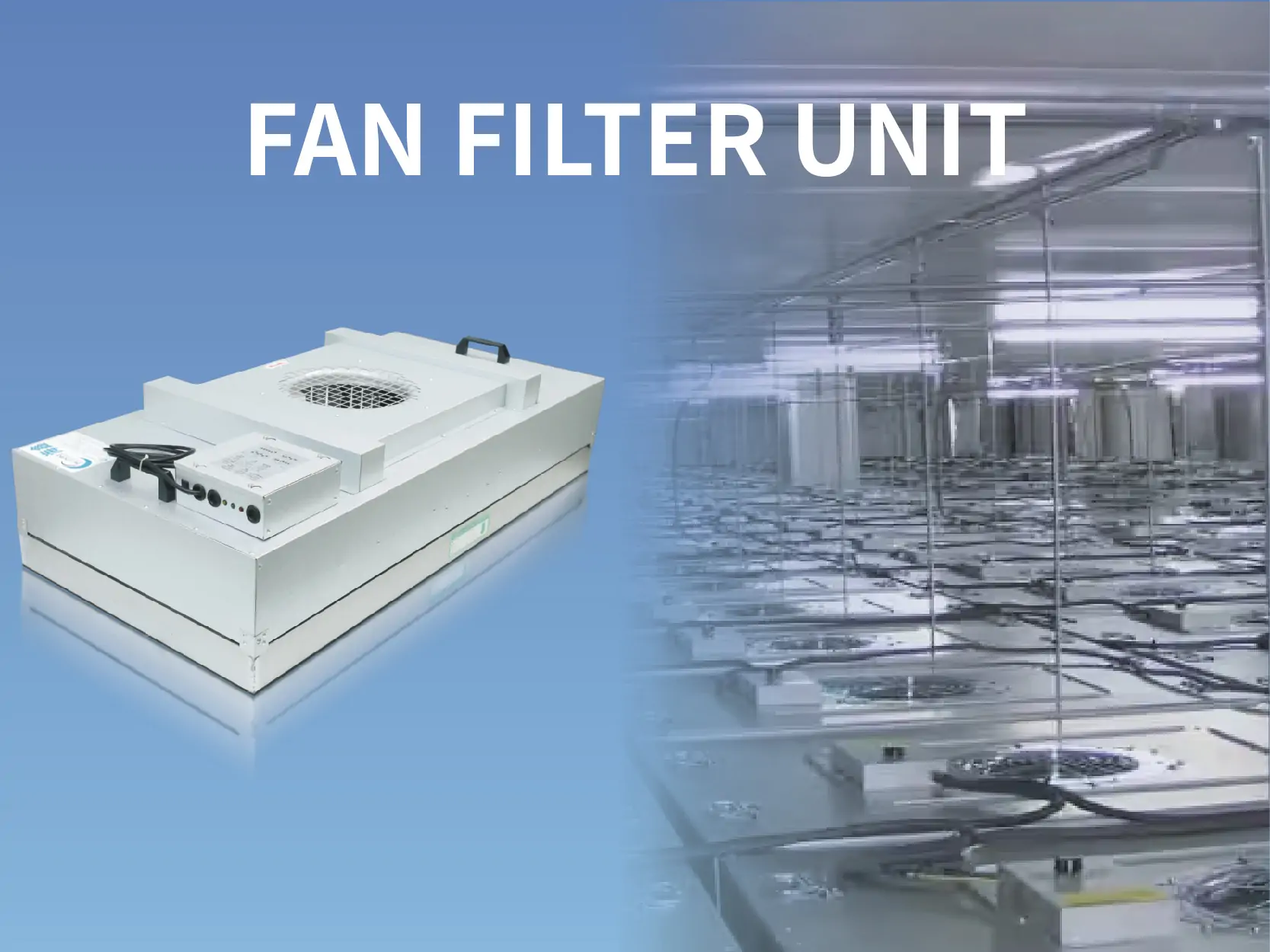
An FFU integrates a fan, a HEPA or ULPA filter, and a control module into a single ceiling-mounted unit. The capital cost profile includes the FFU unit cost, which scales with the number of units and the filter grade; the ceiling grid and suspension, which must support the units and provide service access; electrical distribution and controls, including circuiting and, in zoned designs, group control or monitoring; and installation labor, which is generally simpler than ductwork installation because there is no large duct network to fabricate, insulate, and pressure-test. FFU unit cost accumulates quickly when coverage is high. In an ISO 5 ceiling, FFU equipment alone can dominate the mechanical budget. In an ISO 7 ceiling with low coverage, the total number of FFUs is modest, and the equipment cost is correspondingly lower.