Show the MERV 8 vs 11 vs 13 vs 15 Filter Real HVAC Performance
1. MERV 8 vs 11 vs 13 vs 15: A Quick Performance Comparison
Choosing between MERV 8, 11, 13, and 15 is not simply a matter of selecting the highest available rating. The real decision involves balancing particle removal efficiency, pressure drop, airflow requirements, and installation conditions.
Under ANSI/ASHRAE Standard 52.2, filters are classified according to their particle removal efficiency across three size ranges:
| MERV | E1: 0.3–1.0 µm | E2: 1.0–3.0 µm | E3: 3.0–10.0 µm |
|---|---|---|---|
| 8 | Not rated | ≥20% | ≥70% |
| 11 | ≥20% | ≥65% | ≥85% |
| 13 | ≥50% | ≥85% | ≥90% |
| 15 | ≥85% | ≥90% | ≥95% |
Values represent minimum efficiency thresholds for the respective MERV classifications, not guaranteed results for every product.
For HVAC buyers and engineers, the practical differences extend beyond these figures:
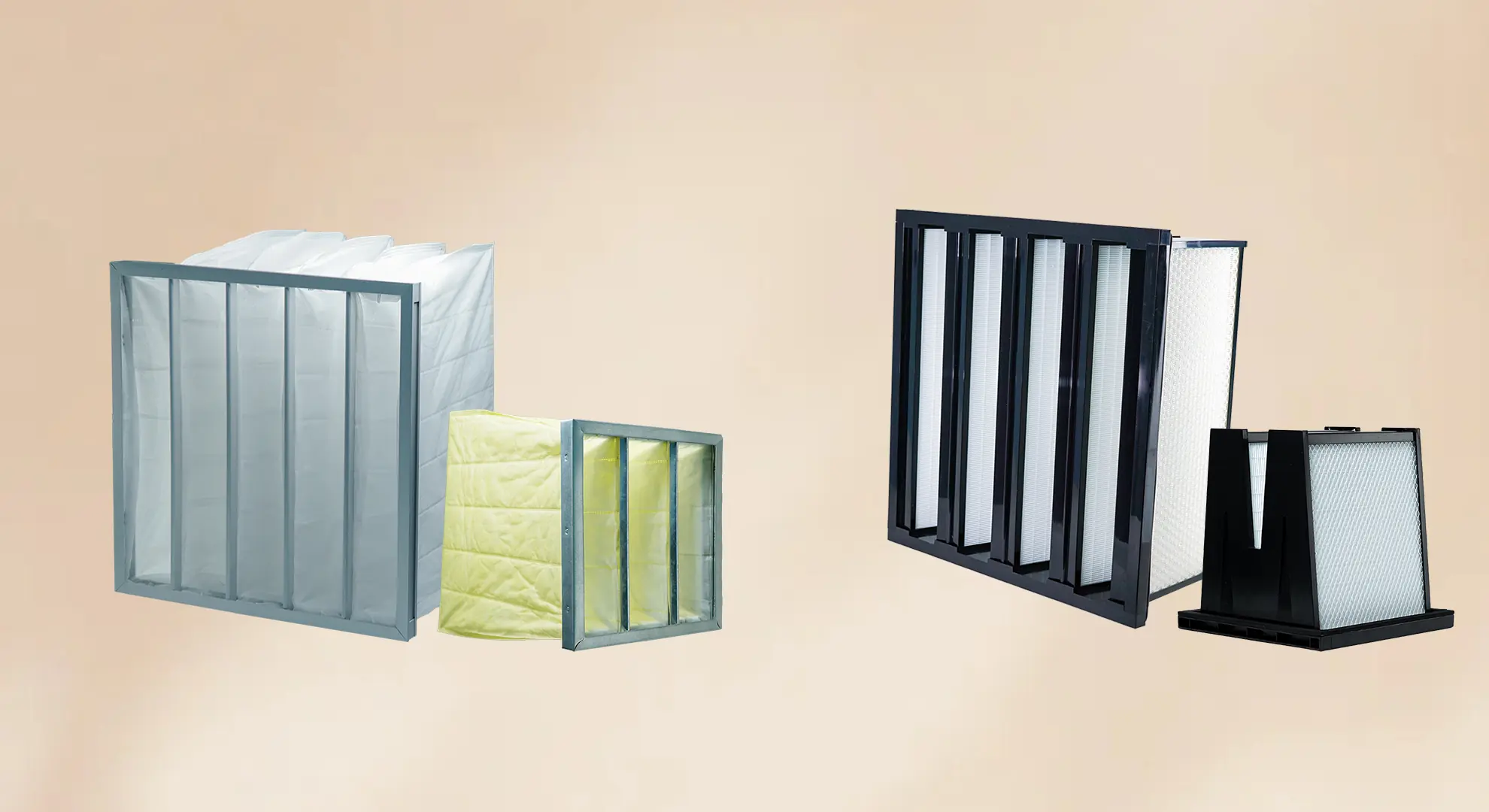
- MERV 8: General-purpose filtration where larger particle capture is the primary requirement.
- MERV 11: An intermediate option when improved fine-particle capture is needed.
- MERV 13: A common choice for applications requiring higher fine-particle filtration.
- MERV 15: Higher-efficiency filtration for applications where the additional performance justifies the system requirements.
Two filters with different MERV ratings may also have substantially different pressure-drop characteristics, even when their filtration efficiencies are similar.
The following sections examine the factors that laboratory ratings alone cannot fully describe.
2. What a Fish Tank and Laser Visualization Actually Show
A fish tank combined with laser illumination can provide a compelling visual demonstration of air filtration.
By directing particle-containing airflow through different filter materials, the demonstration makes differences in particle movement and collection easier to observe.
It is a useful way to introduce the MERV 8 vs 11 vs 13 vs 15 comparison, particularly for audiences unfamiliar with filtration technology.
However, visual particle reduction should not be confused with measured filtration efficiency.
A laser demonstration does not reproduce the standardized particle size distribution, airflow conditions, measurement procedures, or dust-loading requirements of ASHRAE 52.2.
It also cannot evaluate:
- Actual particle removal efficiency by size range.
- Pressure drop at a specified airflow.
- Filter loading characteristics.
- Leakage around the filter frame.
- Performance changes during extended operation.
The demonstration should therefore be treated as a visual explanation, not a product certification or comparative performance test.
For a meaningful filter comparison, laboratory test reports and operating data remain essential.
3. ASHRAE 52.2 vs. Real HVAC Operating Conditions
ASHRAE 52.2 provides a standardized framework for evaluating filter particle removal efficiency. However, its results represent performance under defined test conditions.
Actual HVAC installations introduce variables that are not fully represented by a single MERV classification.
Test Conditions vs. Field Conditions
| Evaluation Factor | Standardized Testing | Real HVAC Operation |
|---|---|---|
| Airflow | Controlled test conditions | Varies with system operation |
| Particle distribution | Defined test aerosol | Depends on building environment |
| Filter loading | Standardized procedure | Variable dust composition and loading |
| Installation | Controlled test arrangement | Depends on rack and installation quality |
| Leakage | Evaluated within test configuration | May occur around installed filter frames |
| Operating duration | Defined test procedure | Extended and variable service periods |
This distinction is particularly important when comparing filters intended for different applications.
A filter that achieves a certain efficiency under laboratory conditions may not deliver the same effective system-level performance if the installation introduces bypass leakage or excessive airflow resistance.
Another consideration is filter conditioning and electrostatic performance. Some media technologies can exhibit changes in efficiency after exposure to certain conditioning or loading procedures.
For this reason, buyers should review the applicable test reports and understand the specific testing and conditioning methods used.
A MERV rating is a standardized product classification, not a complete prediction of installed HVAC performance.