Which is better, activated carbon filter cotton or fiber cotton?
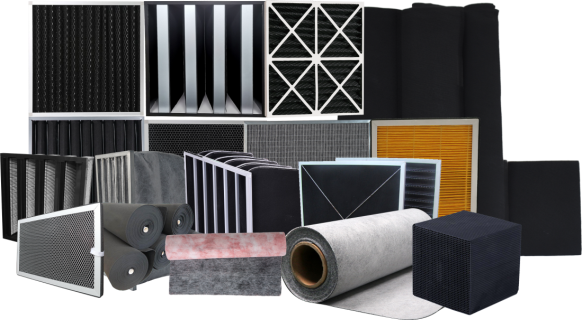
In the air filter industry, filter cotton is divided into four types and the filter effect of each filter cotton will be different:
- Synthetic fiber filter cotton
- Glass fiber filter cotton
- Non-woven filter cotton
- Activated carbon filter cotton
So which one is better, synthetic fiber filter cotton and activated carbon filter cotton?
Activated carbon filter cotton does not mean that a piece of activated carbon is made into cotton. It refers to filter cotton made by immersing synthetic fibers with carbon and glue.
In daily life, there are more applications of activated carbon filters, because activated carbon filter cotton can remove peculiar smells, exhaust gas, odor, etc., and are usually used in home kitchens, bathrooms, hospitals, factories, etc.
It is applied in many places, and it is better for some odors. It depends on its adsorption capacity. Of course, it will also chemically react with some gases and then remove them.
However, the filtration efficiency of the filter using activated carbon filter cotton will gradually decay over time, which is affected by the type and concentration of pollutants.
Generally, it must be used with a single primary or middle-efficiency filter.
Synthetic fiber filter cotton is an emerging filter material and the main development direction of future filter materials. It can fully replace the full range of non-woven fabrics and glass fiber covering coarse, medium, and high-efficiency filtration products under normal filtration environments.
Compared with other filter materials of the same level, it has the advantages of
- Low resistance to airflow
- Lightweight and easy to handle
- Large capacity for filtration
- Environmental protection (can be incinerated)
- Moderate price
Using polyester fiber as the main raw material, abbreviated as: PET, polyester fiber is made of polyethylene terephthalate, also known as synthetic fiber or polyester.
- The specific gravity of polyester fiber is 1.38;
- the melting point is 255~260℃, and it starts to bond at 205℃, and the safe ironing temperature is 135℃;
- the water absorption is poor, only 0.4%;
- the breaking strength of filament is 4.5~5.5 g/denier, Short fiber is 3.5~5.5g/den;
- the elongation at break of filament is 15~25%, short fiber is 25~40%;
- the strength of high-strength fiber can reach 7~8g/den, and the elongation is 7.5~ 12.5%.
Key properties of polyester include:
-
Excellent wrinkle resistance
- Good elasticity
- Dimensional stability
- Good electrical insulation properties
- Resistance to sunlight, abrasion, mildew, and moth
- Good resistance to chemical reagents
- Resistance to weak acids and alkalis
The industry name is chemical fiber, chemical fiber is divided into large chemical fiber and small chemical fiber, and large chemical fiber refers to polyester fiber produced from high-quality PET chips. Small chemical fiber refers to the fiber produced by some small and medium-sized manufacturers from recycled PET chips with poor-quality recycled materials.
Activated carbon filter cotton and synthetic fiber filter cotton have different uses between them, so there is no comparison. When purchasing an air filter, we need to purchase it according to our actual needs. If the environment is too odorous, then select activated carbon filter cotton. If it is purely to filter particles in the air, then choose synthetic fiber filter cotton. It has elementary and middle efficiency The effect is optional.